Labels

Showing posts with label Thailand. Show all posts

Saturday, February 21, 2015

Crossing Border at Arayanprathet & Poipet

Date: 26th December 2015

Arayanprathet is the nearest Thai town to the Cambodian border, only about 6 km away. The border itself is located in central Poipet, open from 07:00 am till 22:00 pm. Seated next to the Thai immigration facilities is Rongkleu Market, which has wide facilities, i.e. banks, cafes, a convenience store, money changers and buses. I must admit that the crossing was very unpleasant experienced for me, especially on Cambodia side. When we passed through the Thai border, we had to walk to the Cambodia Immigration office. The walk in a smelly surrounding was not pleasant at  all. The annoying smells was disturbing my concentration and I felt it was lucky that I don't have to return to this part of the crossing in the future anymore. One time experience is enough. At that point in time, I highly regarded my self, being able to restraint under those inconvenience situation at my stage of age.


Poipet on the other hand is a large town that is well connected with reasonably priced buses to various points in Cambodia. The three major cities of Phnom Penh, Battambang and Siem Reap are each directly connected to Poipet. The bus station is located in the city center near the southwest end of Pub Street. We opted to take the shuttle bus (belonging to a charter buses to Siem Reap) from the Cambodian Immigration border. The shuttle bus pick up point seated next to the immigration office, i.e. follow a walkaway straight ahead after you have done your business with the office. In addition, you really can't wait to get rid of the uncomfortable Poipet once you have stamped the passport. I was lucky I did not pass out though the crowded Immigration office was without AC, and far from fresh air.


Entering Thailand from Poipet is quite a straightforward thing for travellers who do not need to apply visa, like Anne & I, or for those of you who have obtained visa in advance. Since 31st October 2013, Visa-free entry is valid for 30 days. Should you require an extra month, i.e. 2 months, then consider getting visa in advance. For information, Nationals of countries were not permitted visa-free entry but who are entitled to a visa on arrival require proof of onward transport out of Thailand and a 1000 baht fee. The visa is likely to be valid for 14 days (not 15 as sometimes stated).


Many Thais cross the border in the morning on one-day trips to gamble at the casinos in Poipet. Talking about casinos, we were quite surprise to see the modern casino at Poipet though their immigration center is in a very poor condition. However there's a separate line for non-Thais which moves quickly, except during the midday log-jam of tourist bus arrivals.
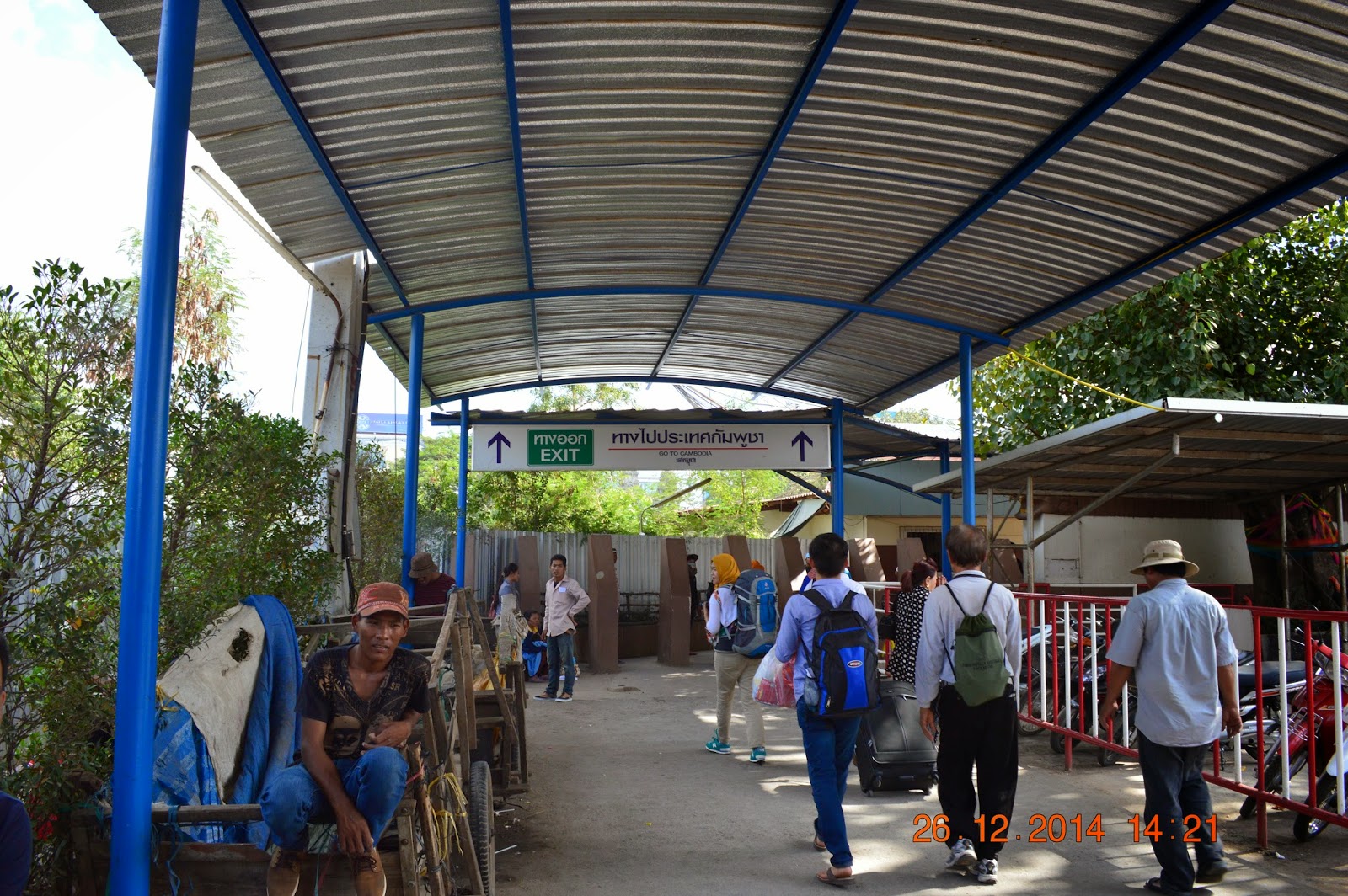


Heading to Cambodia, the formalities of leaving Thailand are simple enough and we were warned from the website about the visa scam and the tuk tuk drivers demanding a high fare. God bless, as we have not facing any problems at all. Even when the tuk tuk driver tried to drop us at a visa centre, we strictly told him “NO”. You see, all of this can be easily avoided. Once you have arrived in Aramyaprathet, getting into Cambodia is simply by doing the following:-
  1. Find a tuk tuk to take you to the border, cost around 80 baht, about 15 minutes journey maximum; and
  2. Exit Thailand through Thai Immigration, cross the walkaway and enter Poipet in Cambodia through Cambodian Immigration. Make sure you stamped your passport at both sides of the Immigration.


Poipet hosts Cambodia's main border crossing with Thailand, which links the north-western Cambodia to Aranyaprathet, and hence Bangkok. Cross-border activity has made the town grow to be larger than its provincial capital, Sisophon. It is located on the fully paved National Highway 5 which runs to Sisophon and then further on the south side of the Tonle Sap Lake to Battambang and Phnom Penh. At Sisophon, National Highway 6 branches off to provide a fully paved arterial route along the north of the Tonle Sap to Siem Reap and Phnom Penh.


While most travellers only pass through, the town can provide the savvy and curiosity looks with some fascinating insights into Cambodia real life. Functionally as a transport hub, the town is relatively easily covered on foot, for those who wish to explore it. Hotels are within walking distance of customs. Poipet is a border town typical of where shocking development disparities exist between two nations, not unlike an impoverished Sungai Kolok in southern Thailand, which borders more prosperous with Malaysia. The town offer the usual Khmer mix of market, stalls, coffee shops and beer gardens.


Beside the bad smells all the way to the Cambodian check point, I found the service provided by the Cambodian immigration officer was rather poor. I'm sharing herewith photos taken inside the immigration office. You would able to see how cramped we were waiting for our turn. The immigration officer simply take their own sweet time to record the foreigners arrival without sense of consideration about the long queue line awaits. Anne and I were both in sweat. Another information to share which I found very weird is that we have to scan all our 5 fingers. Other countries we've been thus far never imposed this kind of practice. It is really strange.


After we both have done with the immigration, the wait for shuttle bus was a God sent. It comes very quickly and we do not have to wait long to catch 1 to the next dedicated bus station. I met a tuk-tuk driver who happened speaks fluent Bahasa Melayu (my native tongue) as he was working for a Malaysian boss in Phnom Penh before. Anne captured a photo of me and him having our nice chat in below photo. I finally found something good to write about in Poipet. This guy has shared quite a useful tips of what not to do in Cambodia. I pray for him and his family of 6 be bliss with happiness and a peace of heart all the time.


A view from and inside the Train to Arayanprathet

Journey date: 26th December 2014

It was our first experience traveling on a train without air-conditioning. Train 275 from Bangkok to Aryanprathet are 3rd-class, which means no air-conditioning and windows are open allowing a substantial cool breeze. Take note that there's ceiling fan beside toilets and sinks. Seats are a mixture of padded benches, padded bucket seats, and wooden benches. If you are taking the afternoon train try to sit on the shady (north) side of the train. The morning sun isn't so bad and doesn't so greatly affect the early departures, but it's still cooler in the north side. Plus, power lines are on the south side, so the view is better as well. 


This local train has given us a great opportunity to watch peoples, beautiful countryside and a wildlife, if you are lucky. During the dry season, smoke and ash can blow through the windows from the burning rice fields. What I like most was the feeling that everybody are equal in that situation. Everyone paid the same fare despite whether you are locals or foreign. The feeling of equality is what I hold strong to my heart as Allah has never differentiate any human being. He is never being judgmental in any ways, always given us a chance to cleanse our self. Another important thing is that I see people as beautiful, no matter what color their skins are. All religion teach us to be kind, hence, there should not be any bad thought or ill feeling when you look into a stranger eyes do "SMILE" despite that they are Buddhist, Jewish, Hindus, Christians, Jains etc as we are all worship God, believe in life hereinafter. 


This entry are to share the sceneries from inside and out as captured by Anne and I in between our moments of silence. I spent most of those 4 hours reading, taking a nap and reflects. Rest of the time Anne and I talked all stuffs about our life, our dreams and our plans for train travels. Please enjoy the photos that we took from our seat.


A local boy played hide and seek when he saw me focusing on him


The man in green shirt was pushing his trolley food up and down at 1 of the station

Local's morning life, a stop at a Railway crossing, a biker with and without helmet


Burned rice field getting ready for the next farming 

Local wooden house by the rice field

Station master?

Our coach were filled with foreigners who were heading towards the same destination with our, crossing Cambodian borders at Poipet to Siem Reap

Train 276 from Aryanprathet to Bangkok on opposite track

Priceless, another coach full the Thai's


Timber sleeper under replacement with concrete sleeper

Sleepers replacement works in progress

Concrete sleeper stock yard area

Out of boredom, showing of my feet to annoy her

Love is sharing and charing for the same pet

Hot and cold


Wednesday, February 18, 2015

Train Rides 2014 - Bangkok to Arayanprathet

Date: 26th December 2014

Bangkok Railway Station, unofficially known by the local as Hua Lamphong Station, is referred to by the State Railway of Thailand as Krungthep Station (Krungthep carry a meaning of Bangkok in English). It is the main railway station in Bangkok. The station is located in the city center in Pathum Wan District and the railway is wholly managed and operated by the State Railway of Thailand. Hua Lamphong is the informal name of the station, widely used by both foreign travellers and locals. I managed to capture the whole station from an external view when we walked to reach the station by foot from the hotel. There's no traffic to stop us viewing a beautiful sight of the station at an early morning.


For locals, the station is commonly referred to as Krungthep Station, and the name Hua Lamphong is not well-known, hence you need to mention “Krungthep” to the transporter. Similarly, all documents published by the State Railway of Thailand (such as train tickets, timetables, and tour pamphlets) the station is uniformly transcribed as Krungthep in Thai. The station was opened on June 25, 1916 right after it achieved 6 years completion of it's construction. The site of the railway station was previously occupied by the national railway's maintenance centre, which was moved to Makkasan in June 1910 before the commencement of the construction. At the nearby site of the previous railway station a pillar commemorates the inauguration of the Thai railway network in 1897.

With no queue Anne successfully purchased our ticket

The station was built in an Italian Neo-Renaissance-style, with decorated wooden roofs and stained glass windows. It's architecture is attributed to Turin-born Mario Tamagno, who with his countryman (another Italian), Annibale Rigotti (1870–1968) who responsible for the design of several other early 20th century public buildings in Bangkok. The pair designed Bang Khun Prom Palace (1906), Ananta Samakhom Throne Hall in the Royal Plaza (1907–15) and Suan Kularb Residential Hall and Throne Hall in Dusit Garden, among other buildings. We used our Iphone to snap the photos at the station. As soon as the ticket was purchased, we offered a Fajar prayer at the Surau, located on the 1st floor (staircase next to the food court and toilet). Thereafter, we tried to look for food but unfortunately no stall was open as yet.  


There are 14 platforms, 26 ticket booths and two electric display boards found at the stations. For the record, Hua Lamphong serves over 130 trains and approximately 60,000 passengers every day. Since 2004 the station has been connected by an underground passage to the MRT (Metropolitan Rapid Transit) subway system's Hua Lamphang Station (see my earlier entry). The station is also a terminus of the Eastern and Oriental Express luxury trains.


2nd return at Krungthep Station - feeling so lucky 

Aranyaprathet, 255 km from Bangkok, is just 6 km away from the Cambodian border post at Poiphet from where buses run to Siem Reap and Bttambang for onward bus or speedboat to Phnom Penh.   2 dedicated trains, train no. 275 (runs in early morning) whilst train no. 280 (runs later in the afternoon). You can't be choosy as they have only a 3rd class seats (take note-free seating), but then the Thai 3rd class train is quite clean and comfortable. In fact it was quite a pleasant way to travel, with vendors selling food & soft drinks in and out.  Both train 279 and 280 is a diesel railcar.


All trains are 3rd-class, which means no air-conditioning and windows open allows for a substantial breeze. There are toilets and sinks. Seats are a mixture of padded benches, padded bucket seats, and wooden benches. If taking the afternoon train try to sit on the shady (north) side of the train (i.e. left from BKK, right to BKK). The morning sun isn't so bad and doesn't so greatly affect the early departures, but it's still cooler in the north side. Plus, power lines are on the south side, so the view is better as well. The train is a great opportunity to watch people, countryside and wildlife. During the dry season, smoke and ash can blow through the windows from the burning rice fields.


Food and drink vendors work around the clock in the cars, providing cheap food and refreshment. Many of the foods were wrapped in banana leaf and easily taken. There's also an exotic food, unimaginable and so peculiar to us including the fried worm. An American who was on the same train with us, gave a try and offered us some. He said that whenever you are in Thailand you had to try their exotic food as we wont be able to find elsewhere. We both  politely turned down his offer. There's also a thick bamboo tubes contain the imaginatively named "bamboo rice", a mildly sweet and savory sticky rice, most easily eaten with chopsticks.


For 255km travelling distance from Bangkok to reach Aranyaprathet, the ticket price is only 48 baht, much cheaper than the tuk tuk fare (6km) to reach the Cambodian border. Please also take note that no reservation is required, you just need to turn up before the departing scheduled train, buy a ticket and hop on like we did. Two trains, no. 275 & 280 as mentioned earlier available every day in each direction connect Aranyaprathet with Bangkok's Hualamphong Train Station. Train to Aranyaprathet depart at 05:55 and 13:05, scheduled to arrive at 11:20 and 18:05 respectively. From Arayanprathet o Hualamphong direction, i.e. to Bangkok, trains leave at 06:40 and 13:55, arriving at 12:05 and 19:55, respectively. We were forewarned for multi-hour delays but the train that day arrives in time in a good weather.


During the rainy season the region around Aranyaprathet was said to be flooded, resulting the train to terminate at an earlier stop, e.g. about 20km before. If that is the case, you may need to get off the train, follow the crowd to the main road north of the railway and wait for a bus that should take you to Arayanprathet or even directly to the border for about 30 baht. But the weather was really on our side. The sky is blue under a hot sun and it was quite humid. We were truly blessed that our whole journey from 25th December 2014 till we return on 3rd January 2015, we did not even encounter a tiny bit of rain.