Labels

Showing posts with label Helsinki. Show all posts

Wednesday, March 23, 2016

Helsinki Helsingfors - The Central Railway Station

Date of visit: 21st October 2015

It was drizzling a bit when we arrived at Helsinki Central Railway Station. The drizzle make it impossible for me to just leave my luggage and crossed the road just to have a good looking photo that shows the overall building and its external facade. So, I shared below photo from the Wikipedia knowing that they would not mind if I did, as I have majority referred to their website as a main source for my blog, especially on reliance to the facts of history. As you can see, the travelogue from my blog, circling about the details background of all places that I visited not only for my personal reference but also for those who might be interested to know about the background story of why 1 building stood there and why people listed it as the attraction, worth visited.


Admittedly, only yesterday I came to know that Helsinki Helsingfors means the same thing. Helsinki is in Finnish whilst Helsingfors is in Swedish language, both refer to the name of the city. Helsinki is the capital and largest city of Finland, in the region of Uusimaa, southern Finland, on the shore of the Gulf of Finland, an arm of the Baltic Sea. Helsinki is located about 80 kilometres north of Tallinn, Estonia and 400 km northeast of Stockholm, Sweden. It is 388 km west of Saint Petersburg, Russia. Helsinki has a close historical connections with Talinn, Sweden and St Petersburg as what has been explained in my earlier entry on Fortress Suomenlinna.


The word at the back is "Helsingin Paarautatieasema-Helsingfors", the station name

Helsinki Central railway station is a situated in Kluuvi, part of central Helsinki. It has been a focal point of public transport, not only within Finland city but it connects the city with cities across the border. The station is used by approximately 200,000 passengers per day, making it Finland's most visited building. It serves as the point of origin for all trains in the local VR commuter rail network, as well as for a large proportion of long distance trains in Finland. The station also hosts the Rautatientori metro station, which is the busiest station of the Helsinki Metro. On 7 June 2010, the station was officially renamed Helsingin Paarautatieasema-Helsingfors central station. The Finnish transport bureau use "Helsinki C" as a shorthand, and there were erroneous news reports that this shorthand would also be taken into official use. The Turku Central railway station was renamed in a similar manner.


The building was designed by Eliel Saarinen and inaugurated in 1919. It was chosen as one of the world's most beautiful railway stations by BBC in 2013. In 2011, the Monocle magazine ranked Helsinki as the most liveable city in the world in its "Liveable Cities Index 2011". In the Economist Intelligence Unit's August 2015 Liveability survey, assessing the best and worst cities to live in globally, Helsinki placed among the world's top ten cities.


The station is mostly clad in Finnish granite, and its distinguishing features are its clock tower and the two pairs of statues holding the spherical lamps, lit at night-time, on either side of the main entrance. Animated characters based on the statues have recently been featured in some major advertising campaigns by Finland's government-owned railway operator, VR. Well, if you ask me, my most favorite area of the station was when we sat inside VR ticket counters. I've been treated well by VR friendly's staff when I encountered some careless attitude that I wrote about it in "Train ride 2015-Helsinki to St Petersburg".


The first railway station in Helsinki was built in 1860, as Finland's first railway between Helsinki and Hameenlinna was opened. The station's plans were drawn by the Swedish architect Carl Albert Edelfelt. However, as the popularity of railways grew, the station turned out to be too small, and a contest was organised in 1904 with the intention of producing plans for a new station. The contest received 21 entries, and was won by Eliel Saarinen, with a pure national romanticist design, which sparked off a vigorous debate about the architecture of major public buildings, with demands for a modern, rational style. Saarinen himself abandoned romanticism altogether and re-designed the station completely. The new design was finished in 1909 and the station was opened in 1919.


The railway station has been renovated occasionally. In the 1960s the underground Asematunneli tunnel was built. The first surveillance cameras in the station hall were installed in the spring of 1968. The first electric train recorded arrived at the station was on 13 January 1969. After testing, regular electric train traffic was started between Helsinki and Kirkkonummi railway station on 26 January 1969.


In 1982, Rautatientori metro station was built under the railway station forecourt as part of the Helsinki Metro construction work. In 2000, a glass roof, which had already been in the original drawings by Eliel Saarinen, was built over the railway station's central platforms, although to a new design. In 2003, the shopping wing Kauppakuja was opened along with a hotel.


There are 19 platforms at the station. Numbers 1–3 are on the east side and serve local trains on the Tikkurila route, their tracks stop short of the main station roof. Numbers 4–11 in the centre of the station are the main platforms for longer-distance trains which stretch down to terminate in front of the main station building, commonly 5–10 serve trains running via Tikkurila to Tampere, St Petersburg and other points north and east, while 11–12 serve express trains via the Espoo line to Turku. Numbers 12–19 are on the west side and serve local trains on the Espoo and Vantaankoski routes, again their tracks stop short of the main station roof. The tracks funnel into separate express and local tracks for both the Espoo and the Tikkurila routes with the express tracks in the middle and the local tracks on the outside, aligning with their respective platforms. This gives 8 principal tracks but there is a 9th, additional express track for the Tikkurila route out through Pasila in the Helsinki suburbs, the first station at which all trains stop, 5 minutes out of Helsinki main station.


Steam locomotives were replaced by diesel in the 1950s on Finnish railways, and in turn the first electric trains were introduced in 1969 till 1970 on the Helsinki local lines; the trains introduced at that time are still in substantial use. Main line trains were then gradually changed over as the electric network was extended over the bulk of the Finnish rail system, including all trains which serve Helsinki. Helsinki station serves as a central hub for Finnish transport. There is a bus station on both sides of the main station building. The Helsinki Metro Rautatientori station is located under the main station building, linked through the Asematunneli pedestrian underpass and underground shopping centre complex, which has entrances in the main hall of the station and at various points in the surrounding city centre streets. The majority of Helsinki's tram routes pass in front of or to the west of the station.


There are two regular bus connections between Helsinki Central railway station and Helsinki-Vantaa airport. One of them is a municipal connection operated by HSL. As an exception for HSL bus lines, the line can only be used for inter-city transport. Once a passenger boards the bus they may only disembark after crossing the border to Vantaa. The other bus connection is a private express bus operated by Finnair. It does not accept HSL tickets.


I hope I would be able to start writing tomorrow about the first city in Russia, that we arrived, i.e. St Petersburg!

Tuesday, March 22, 2016

Helsinki - The Cathedral at the Senate Square

Date of visit: 20th October 2015

The Senate Square is one of the main tourist attractions of Helsinki, so remember to visit should you have arrived in the city. There are plenty of activities happening around the place, from concerts to snow buildings to controversial snow board that has been set up on the Senate Square. Senate Square and Helsinki Cathedral becoming one of Helsinki's most popular attractions among the tourist as well as to the locals. More than 350,000 people visit Helsinki Church each year on 2 reasons, attended to religious events, but mostly as tourists, like me. The church is in regular use for services of worship and weddings.


The Square was an outstanding design work by Carl Ludvig Engel's which its architecture display a unique symbol of political, religious, scientific and commercial powers in the centre of Helsinki city. Senate Square and its surroundings make up the oldest part of central Helsinki. Landmarks and famous buildings surrounding the square are the Helsinki Cathedral, the Government Palace, main building of the University of Helsinki, and Sederholm House, being the oldest building of central Helsinki dating from 1757.


The square overlooking University of Helsinki

The Palace of the Council of State was completed on the eastern side of the Senate Square in 1822 and now houses the offices of the Prime minister of Finland and the cabinet. The main University building, on the opposite side of the Senate Square, was constructed in 1832. The Helsinki Cathedral on the northern edge of the Senate Square was Carl Ludvig Engel's longest architectural project. He was working on it from 1818 until his death in 1840. The Helsinki Cathedral, then called the Church of St. Nicholas dominates the Senate Square, and was finalized 12 years after the architect’s death, i.e. in 1852. What makes the cathedral unique is due to its steep steps.


Sederholm House

A statue of Emperor Alexander II is located in the center of the square. The statue, erected in 1894, was built to commemorate the emperor re-establishment of the “Diet of Finland” in 1863 as well as his initiation of several reforms that increased Finland's autonomy from Russia. The statue comprises Alexander on a pedestal surrounded by figures representing law, culture, and peasants by a sculptor, Walter Runeberg.


During the Russification of Finland from 1899 onwards, the statue became a symbol of quiet resistance, with people protesting against the decrees of Nicholas II by leaving flowers at the foot of the statue of his grandfather, then known in Finland as "the good czar". After Finland's independence in 1917, demands were made to remove the statue. Later, it was suggested to replace it with the equestrian statue of Mannerheim currently located on Mannerheimintie in front of the Kiasma museum. Nothing came of either of these suggestions, and today the statue is one of the major tourist landmarks of the city and a reminder of Finland's close relationship with Imperial Russia.


Helsinki Cathedral is the Finnish Evangelical Lutheran cathedral of the Diocese of Helsinki. It was built as a tribute to the Grand Duke of Finland, Tsar Nicholas I of Russia, known as St Nicholas' Church until the independence of Finland in 1917. The cathedral stood on a distinctive landmark in the Helsinki cityscape, with its tall, green dome surrounded by four smaller domes, reflecting its neoclassical design. The church's plan is a Greek cross (a square centre and four equilateral arms), symmetrical in each of the four cardinal directions, with each arm's facade featuring a colonnade and pediment. The architect intent to place a further row of columns on the western end to mark the main entrance opposite the eastern altar, but it was never built.


The cathedral was built on the site of the smaller Ulrika Eleonora Church, which was dedicated to its patroness, Ulrika Eleonora, Queen of Sweden. A facsimile of this church, made entirely from snow, was constructed on Senate Square in the early 2000s. Helsinki Old Church was built between 1824 and 1826 in nearby Kamppi to serve the parish while the Ulrika Eleonora Church was being demolished and until the consecration of the new cathedral.


The building was later altered by  Carl Ludvig Engel's successor, Ernst Lohrmann. He placed 4 small domes emphasise the architectural connection to the cathedral's model of Saint Isaac's Cathedral in St. Petersburg. Lohrmann also erected 2 free-standing bell towers, as well as larger-than-life sized zinc statues of the Twelve Apostles at the apexes and corners of the roofline. The altarpiece was painted by Carl Timoleon von Neff and donated to the church by emperor Nicholas I. The cathedral crypt was renovated in the 1980s by architects Vilhelm Helander and Juha Leiviska for use in exhibitions and church functions; Helander was also responsible for conservation repairs on the cathedral in the late 1990s.


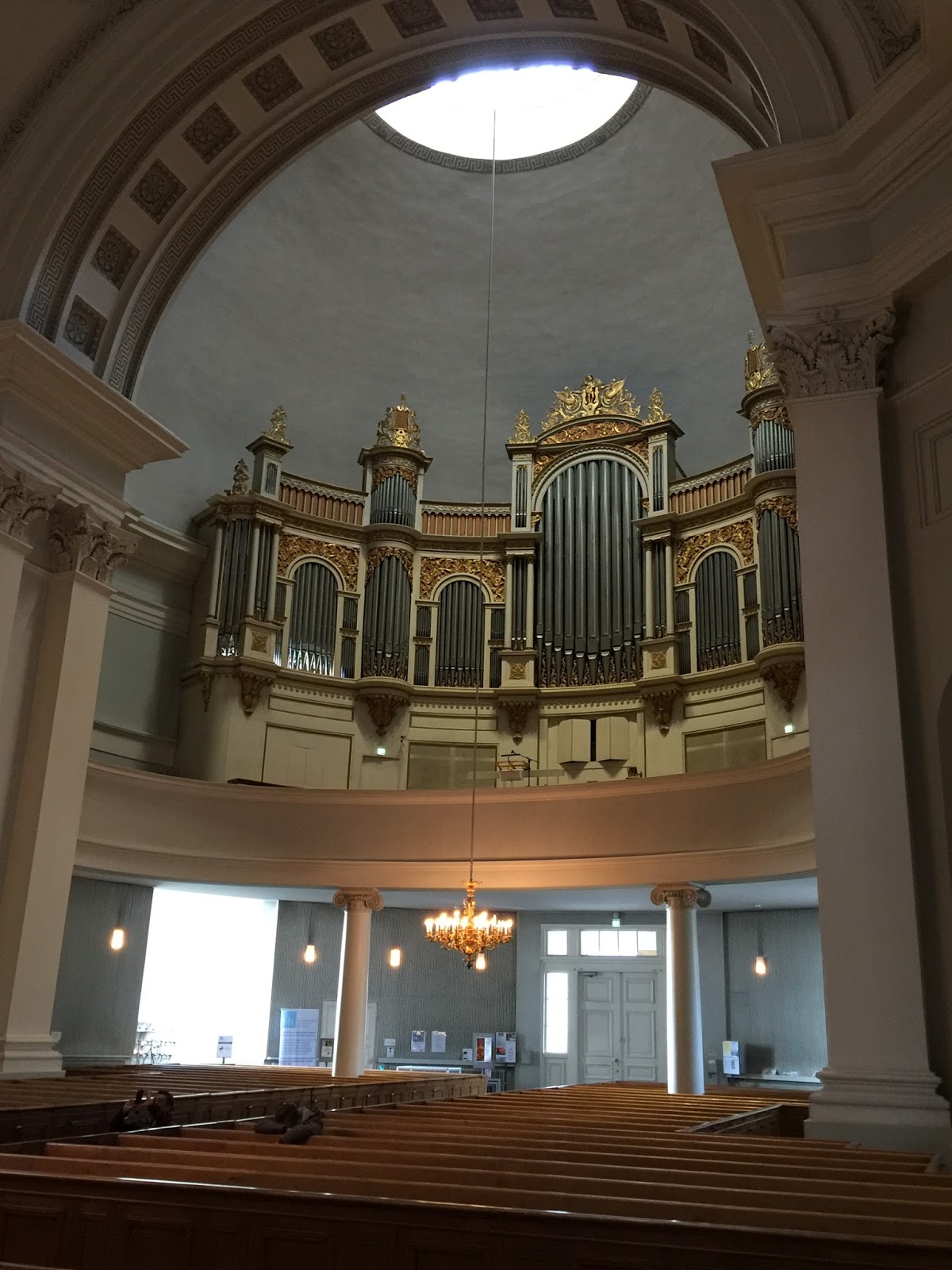
The Cathedral is quite lovely and beautifully decorated inside in an unusually elaborate style for those of the Lutheran faith. Catholic churches are often much more grand with stained glass and ornate fixtures. The predominance of the Lutheran faith is the stronghold of Finland historically. I spent quite sometime inside the white cathedral whilst Anne sat peacefully at the square. Very wise of her not willing to climb up the steep stairs. It's quite scary to see from the top level of the cathedral, honestly. But the feeling inside Helsinki cathedral brought some kind of peace, similar feeling that I had when having a silent prayer with my former colleague when we were inside Lotus Temple in Delhi. Admittedly, this church has eliminate quite a large number of mythology statue, especially to the sun worshipers who negotiated good terms when they first started building the Roman churches in Vatican City, the founder of Christianity.  


My apology for a long entry and for too many photos that I've shared this time. I cant' wait to start writing my experience in the 2 Russian cities, St Petersburg and Moscow. Good day everyone, may you have loves, compassion and forgiveness in your heart to all human kind and animals always.

Monday, March 21, 2016

Helsinki - Uspenski Cathedral

Date of visit: 20th October 2015

I've snapped quite a number of panorama photo of Uspenski Cathedral from a distance. The one that I like most was when snapped it from the nearby garden. The cathedral is located on a hilly side that is noticeable even from a far distance. The picture view looks even more stunning when it was added with a beautiful landscape. See some of it in below photos.


Uspenskin katedraali is how the Finnish pronounce it, is an Eastern Orthodox cathedral in Helsinki, Finland. It was built in dedication to the Dormition of the Theotokos or the Virgin Mary. Its name comes from the Old Church Slavonic word "uspenie", which denotes the Dormition. The cathedral was designed by the Russian architect Aleksey Gornostayev but it was only built after his death in 1862. It was completed in 1868, took only 4 years to complete this magnificent piece structure suited its maiden name, Virgin Mary.


The crypt chapel of the cathedral is named after the holy Alexander Hotovitzky, who served as vicar of the Orthodox parish of Helsinki between 1914 till 1917. I wish to share below photo from Ftiogatalk.blogspot.com that the blog owner snapped from the inside the cathedral. Saint Alexander Hotovitzky was a Ukrainian who came to the United States in the 1890s as a lay missionary and was ordained to the priesthood while he was there. He was to become vicar of the congregation of the Russian Embassy in Berlin. Because of the outbreak of the First World War he was instead made vicar of the Orthodox congregation in Helsinki, which was part of an imperial Russia. In 1917 he was assigned to Christ the Savior Cathedral in Moscow. After the Bolshevik coup he was subjected to many cruelties by the revolutionaries as he defended the Orthodox faith, his people, and church property. He was executed during the Great Purge on August 19, 1937, died as hieromartyr.


The Cathedral is set upon a hillside on the Katajanokka peninsula overlooking the city. On the back of the cathedral, there is a plaque commemorating Russian Emperor Alexander II, who was the sovereign of the Grand Duchy of Finland during the cathedral's construction. Main cathedral of the Finnish Orthodox Church in the diocese of Helsinki, Uspenski Cathedral is claimed to be the largest Orthodox Church in Western Europe.


Admission to the Cathedral is free of charge. In winter, the Cathedral is closed on Mondays and that was the reason why we could not enter on the day that we arrived. 20th October 2015 was Monday. So guys, do take note, not to attempt visit on Mondays during winter. I was reluctant to leave the cathedral compound, wishing and praying for a  miracle that someone would open that huge entrance door for me. It felt that a visit without exploring the beautiful prayer hall inside seems to be an incomplete mission. 


The cathedral has quite a number of valuable icons and a few has been stolen. Among others are St. Nicolas The Wonder Maker, which was stolen on 16 August 2007 between midday and 1 p.m. in broad daylight while hundreds of tourists were visiting the cathedral. The icon is from the 19th century and is of a rare item. It was originally given to the Orthodox Cathedral of Vyborg, from where it was moved to Helsinki during the Second World War. No further details of its origin are known. 


The icon, being 45 by 35 centimetres (18 in × 14 in), was placed in a kiota (a glass covered protection frame) and weighs a couple of kilograms. It was on display on a lectern. The icon is now being searched for in Finland as well as abroad. Another icon, Theotokos of Kozeltshan was stolen in June 2010, but recovered in February 2011.


Source of info: Wikipedia

Friday, March 18, 2016

Helsinki - Market Square

Date of visit: 20th October 2015

Everyone who has been to Helsinki was recommending to us that Market Square is a must visit place. I was a little bit disappointed when I first saw the market in the morning. Not much stalls were at the square but I thought to myself that maybe it was too early, still. But then again, after we return back from Fortress Suomenlinna in the afternoon, there's not much improvement in terms of the number of stall. Not that many if we were to compare to the market square in many other cities.


The Market Square, called “Kauppatori” in Finnish is a central square in Helsinki, Finland, and one of the most famous market places and tourist attractions in the city. As it happens that this are the main place for a tourist to catch a ferry or boat to Fortress Suomenlinna.


It is located near the centre of Helsinki, at the eastern end of Esplanadi and bordering the Baltic Sea to the south and Katajanokka to the east. The Helsinki City Transport maintains an all-year-round ferry link from the Market Square to Suomenlinna, and in the summer there are also private companies providing ferry cruises, both to Suomenlinna and other nearby islands. You may see a lot of other things from this place, beside a quay to depart to the Fortress Suomenlinna.


Among other things are, both Helsinki Cathedral and Uspensky Cathedral seated so nearby from where the market square is. Both cathedrals are visible from the Market Square. Infant, mostly all important attractions, or a must visit is reachable by foot, seated not far from another. This are the city that we did not relying on Google Map at all.


From spring to autumn, the Market Square is bustling with activity with vendors selling fresh Finnish food and souvenirs. There are also many outdoor cafés at the square that a visitor must make effort to stop for lunch or at least a coffee break while savoring a local dessert. Some cafes in this area also provide meat pastries called "lihapiirakka". But we were told that the height of the square's popularity is in early October, where we were visiting, when the annual Helsinki herring market ("silakkamarkkinat" in Finnish) begins. Below photos are among those herring that I've first tested in Amsterdam.


Another even that is famously held at the Market Square is an old American cars displays at the Market Square on the first Friday of May month. A long tradition at the Market Square is a display of old American cars on the first Friday of every month. Any motorist with an interest in old American cars can take part in this display. How the tradition originally started is unclear.

Market Square monument structure

Among items that were put up for sales

Please take note that the Market square is the most convenience place for you to buy local souvenirs to bring back as moment. Seagulls have become an increasing menace in the Market Square, swooping down to snatch snacks and ice-cream from the hands of unsuspecting tourists.