Labels

Monday, December 28, 2015

Hamburg - Hamburg Hauptbahnhof

Date: 13th & 14th October 2015

Hamburg Hauptbahnhof is the main train station in the city of Hamburg and is being classified by Deutsche Bahn (German’s Railway Company) as a category 1 station. It was opened in 1906 to replace the original 4 terminal stations. The station is operated by DB Station & Service AG, a subsidiary of Deutsche Bahn that is responsible in managing over 5,000 train stations on the German railway network. With an average of 450,000 passengers a day (twice bigger than average passengers in Amsterdam Centraal), the station is the busiest in Germany and after the Gare du Nord in Paris, the 2nd busiest in Europe.


The central station is a through station with island platforms. It is a major transportation hub, connecting long distance trains, i.e. Intercity-Express lines and being part of the underground rail network of the Hamburg U-Bahn (MRT) and S-Bahn (LRT), situated right in the city centre, the Hamburg-Mitte borough. Part of its building is being used as a pretty decent shopping centre. There’s a lot more shopping street adjacent to the station for those who has a desire to shop while on transit. Rest assured, the signage and the map of this building will guarantee that no one will lost their way back to their designated platform.


Before this station was opened, Hamburg had several smaller stations located around the city centre. The first railway line was opened on 5 May 1842, coincidentally the same day with the "great fire" that ruined most of the historic city centre. These stations (see below list) however were by few hundred metres away from the others):
  • Berliner Bahnhof (1846), located at the place where the Deichtorhallen can be found today, on the right bank of the Elbe river; terminus of the line to Berlin;
  • Lubecker Bahnhof (1865), terminus of the line to Lubeck;
  • Klosterthor Bahnhof (1866), eastern terminus of the Hamburg-Altona link line; and
  • Venloer Bahnhof (1872), since 1892 named "Hannoverscher Bahnhof", on the line across river Elbe, in Harburg split in the lines to Venlo and to Hanover
Snapped from the hotel that we stayed 

The communication lines between the above stations partly were built in squares and streets, provisionally. The state government decided and officiate the new location for the central station in 1900. The Hamburg Hauptbahnhof was designed by the architects Heinrich Reinhardt and Georg Sußenguth, modeled after the Galerie des machines by Louis Beroud of the World's Fair of 1889 in Paris. It was built within 5 years from 1902 to 1906. The German emperor William II rejected the first draft but the second draft was eventually constructed. The emperor personally changed the Art Nouveau style elements into Neo-Renaissance, giving the station façade look as a fortification like character. The station was first opened for visit on 4 December 1906 whilst the first train arrived the next day, and scheduled trains started officially 2 days later.


During the Second World War on 9 November 1941, the station was hit seriously by Allied bombing. Several areas needed to be rebuilt completely, like the baggage check and the eastern ticket counters. One of the clock towers was destroyed in 1943 and the station has been renovated from 1985 to 1991 the station was renovated.


Hamburg Hauptbahnhof occupied an area of 206 m x 135 m and is 37 m roof high. It has 8,200 m2 rentable area and 27,810 m2 built up area in total. The clock towers at the station building are 45 m, and the clocks have a diameter of 2.2 m (see attached photos in this entry). Adjoining the station building, the track hall is constructed of iron and glass and spans the main line platforms and 2 LRT (S-Bahn) tracks. The platforms are reached from two bridges on street level, one at each end of the track hall, from the northern bridge on stairs and by lifts, from the southern bridge by escalators. Two other S-Bahn tracks and the subway tracks are in a connected tunnel system.


The Wandelhalle (Promenade Hall) in the station building is a small shopping centre with extended opening hours. It was built in 1991 during the renewal of the beam construction. It is located on the northern bridge and includes restaurants, flower shops, kiosks, a pharmacy, service centres and more. The upper floor also has a gallery surrounding the hall.


Since 2008, in an effort to disperse drug dealers and users from the area, Deutsche Bahn has been playing classical music like Vivaldi's The Four Seasons which according to the German newspaper Hamburger Abendblatt is a success to chase away the criminals. Also in the same year, 720 regional and long distance trains, and 982 S-Bahn trainsis recorded served the station per day. There were 6 platforms for the main lines.


Hamburg Hauptbahnhof is one of the largest stations in northern Germany and connects Denmark with central Europe. There are permanent Inter City Express lines to Berlin, Frankfurt continuing to Stuttgart and Munich, and Bremen, continuing to the Ruhr Area and Cologne. To the north ICE trains connect Hamburg with Aarhus and Copenhagen in Denmark and Kiel in Schleswig-Holstein. There are also several Inter City and Euro City passenger train connections. The station is a hub for international travel, and most passengers to or from Scandinavia must change in Hamburg. That was the main reason why we made a quick stop in this city. You may read the link about our train adventures in this city, arriving from Amsterdam to Hamburg and departed from Hamburg to Copenhagen.


The following lines connect to the station are:-
  1. Berlin–Hamburg railway
  2. Hanover–Hamburg railway
  3. Wanne-Eickel–Hamburg railway (to Bremen and the Ruhr)
  4. Lower Elbe Railway
  5. Lubeck–Hamburg railway
  6. Hamburg-Altona link line (connecting to Hamburg-Altona–Kiel railway)
  7. Intercity Express services (ICE 28) Hamburg - Berlin – Leipzig - Jena - Nurnberg - Munich (- Innsbruck)
  8. Intercity Express services (ICE 75) Copenhagen - Lubeck - Hamburg - Berlin
  9. Intercity Express services (ICE 76) Aarhus - Padborg - Flensburg - Hamburg - Berlin
  10. EuroCity services (EC 7) Hamburg - Bremen - Munster - Dortmund - Dusseldorf - Koln - Bonn - Karlsruhe - Freiburg - Basel - Zürich - Chur
  11. EuroCity services (EC 27) Hamburg - Berlin - Dresden - Prague - Brno - Bratislava - Budapest
  12. Intercity services (IC 30) Hamburg - Bremen - Münster - Essen - Düsseldorf - Köln - Bonn - Stuttgart
  13. Intercity services (IC 31) Hamburg - Bremen - Munster - Dortmund - Wuppertal - Koln - Bonn - Frankfurt


Sunday, December 27, 2015

Christmas Day, 2015 - Nasrul is officially 18sx

I wasn't home to celebrate Nasrul's birthday last year as I was in Hanoi for the 3rd leg train rides. But his birthday was greatly spent caused his father, who hopelessly adored him make sure that he gets what he wanted on his last birthday. For this year, on Christmas day, we thought of spending a night stay at Bukit Tinggi resort but the rate per night was nearly RM1,500 due to a peak holiday season. Hubby said it's not worth it, hence we rescheduled the vacation to Langkawi instead. 

Birthday lunch at D'Templer

Syahirah insisted to go since her leave was approved. Bukit Tinggi is located not far from Kuala Lumpur, therefore it is possible to make a day trip. We did as that, planned a day tour to celebrate this Apple's boy birthday. We started off at 12 noon from home and stopped for birthday lunch at D'Templer, a chinese muslim restaurant on our way heading towards Karak Highway. Thereafter, we drove straight to Bukit Tinggi to see whether or not we shall missed anything for not spending a night. The place was full with tourist, local and foreign as it was a Christmas Day. We could not stand so long with so much crowds at a small place. 


We adjourned to the Botanical Garden and Japanese Village which was part of the Berjaya Hills resort attractions. Truly amazing to be inside the beautiful gardens. Everybody enjoys the trip so much, especially the birthday boy. Happy birthday my Apple boy, you are the reason that I look forward for tomorrow to see how well you growth. May your sister and brothers shall love and protect you even after we, your parents has left this world. Please remember what and where we spent on 25th December 2015. I was really happy when he started to pose for photo, being a camera shy person.

Beautiful fish pond in Botanical Garden

Started posing for photos after a cold response earlier on

They are so much in hate & love relationship

In a happy mode!

Hugged him tightly promising that this was the last photo

Once we were back in Kuala Lumpur, we agreed for a place to a birthday dinner, i.e. western food at Victoria Station, Jalan Ampang. Everyone's however agreed that we need to go for places where there are burgers. Yes, Nasrul simply loves burger and Nachos.

Birthday dinner at Victoria Station

Thursday, December 24, 2015

Amsterdam Centraal Railway Station

Date: 11, 12 & 13th October 2015

When one arrives in a new city, they would be in a hazy state not being familiarized with the new situation. The same situation happened to me when we arrived in Amsterdam Centraal railway station on 11th October. What I pictured in my head was a grandeur, old looking station as I've seen a photo of this station before. From the point where we arrived till the place where we waited for a cab, I could not figured out where was that building has gone as everything that I've seen that morning has a modern features. The story behind the evolution (what I prefer to name it) is finally discovered when I did my read from the wikipedia yesterday. I copied those important facts and paste in this entry from wikipedia website for my future reference and for your knowledge too, should you too interested to know more.

The best that I captured on 12th October 2015

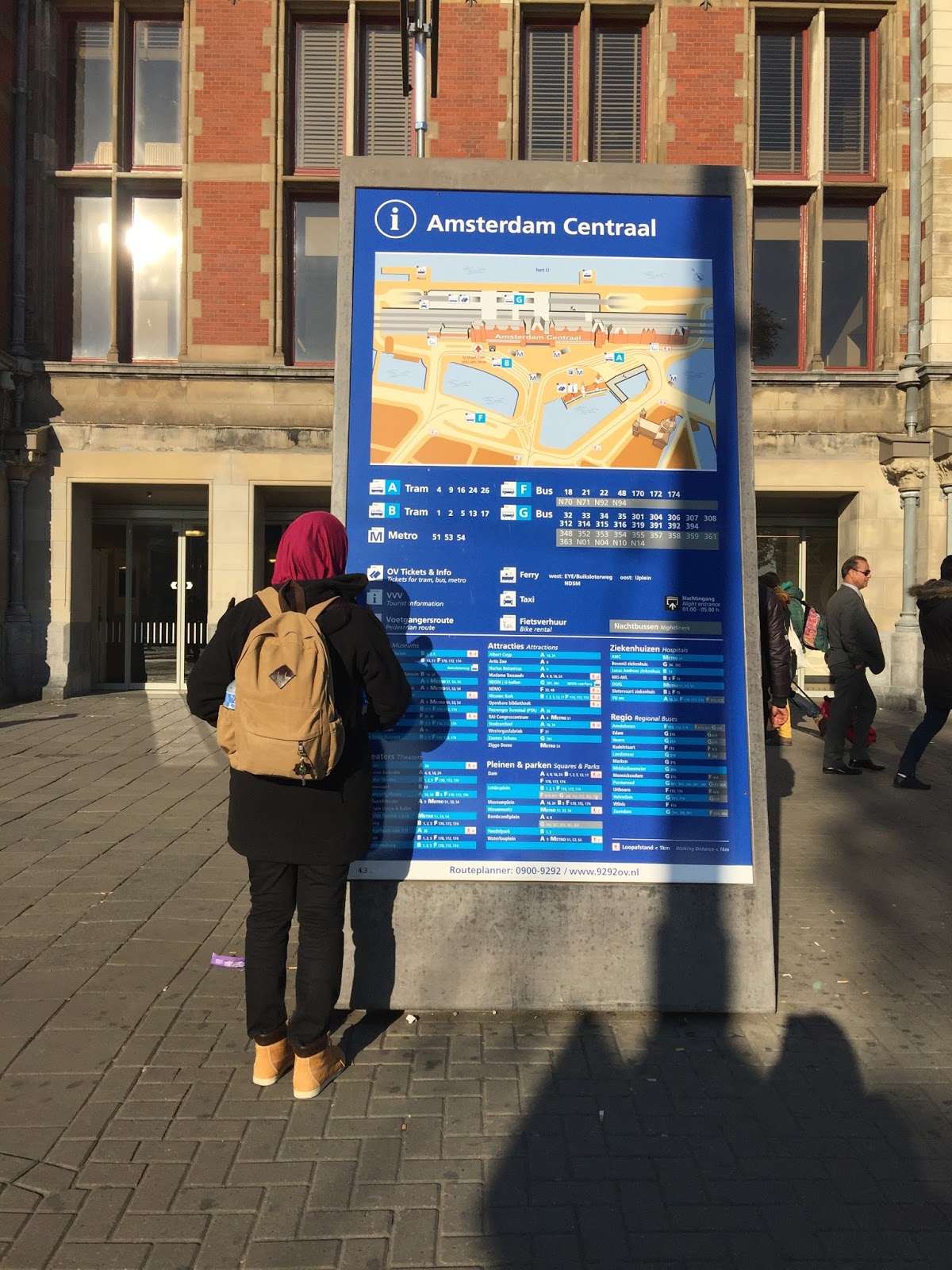
Station Amsterdam Centraal is the largest railway station while being a major national railway hub of Netherland. It is used by approximately 260,000 passengers daily and is the 2nd busiest railway station in Netherland after Utrecht Centraal. The train station has been recorded as the most visited national heritage site of the Netherlands. The station principal rail operator who managed a national and international railway services is NS. Amsterdam Centraal is the northern terminus of Amsterdam Metro Routes 51, 53, and 54, operated by municipal public transport operator GVB. It is also served by a number of GVB tram and ferry routes as well as local and regional bus routes operated by GVB, Connexxion and EBS. We had a chance of taking a GVB trams seated only at the station main entrance on the 12th October and please take note that you may buy tram ticket from the tram operator without a need to look for a machine outside. Remarks: International routes and intercity train is usually entered a back entrance which explains my confusion. 

The day we arrived on 11th October 2015
The day we departed from the city on 13th October 2015

The beautiful Amsterdam Centraal building was designed by the Dutch architect, Pierre Cuypers and was first opened in 1889. It features a Gothic/Renaissance Revival station building and a cast iron platform roof spanning approximately 40 metres. Since 1997, the station building, underground passages, metro station and the surrounding area have been undergoing major reconstruction and renovation works to accommodate the North-South Line metro route, which is due to open in 2017.


The architect, Pierre Cuypers is also known for his design of the Rijksmuseum in Amsterdam which explains the similarity of their facade design and reminded many regarding contemporaries of medieval cathedrals. While Cuypers was the principal architect, it is believed that he focused mostly on the decoration of the station building and left the structural design to railway engineers. The station was built by contractor Philipp Holzmann. The new central station replaced Amsterdam Willemspoort Station, which had to be closed down in 1878, as well as the temporary Westerdok Station that has been used from 1878 to 1889.

Snapped this photo before we boarded the canal cruise

The idea for a central station came from Johan Rudolph Thorbecke, then the Netherlands Minister of the Interior and responsible for the national railways, who, in 1884, laid two proposals before the Amsterdam municipal council. In the first proposal, the station would be situated between the Leidseplein and the Amstel River. In the other, it would be built in the open harbour front allowing for the station to be connected to the existing main lines in the area to the west and the south, but also to a projected new northern line.


The station building was completed in 1884, but the commission to the architect, Cuypers did not include the roofwork of the platforms. The roof, consisting of 50 curved trusses and a span of almost 45 meters, was designed by L.J. Eijmer, a civil engineer with the private railroad company Staatsspoorwegen. The roof was manufactured by Andrew Handyside and Company of Derby, England. Cuypers did design the decorations for the trusses and the gable ends. In October 1889, the station was officially opened, drawing a large numbers of crowds. The visitors were charged 0.25 guilders to see the magnificent station. The opening of the central station marked the city's transition from a waterfront city to an inland city, spurring further redevelopment activities in the city centre which included the realignment of streets and the filling up of canals.


In the 1950s, a pedestrian tunnel was created between the station and the road in front of it, which terminated inside the station. With the construction of the metro tunnel in the late 1970s, both the pedestrian tunnel and the road in front of the station disappeared. In the early 1980s, the central hall and middle tunnel were considerably widened and modernized. In the 1990s, a new signaling post was built on the western side of the station. In addition, the number of tracks on that side was expanded in order to increase capacity in the direction of Sloterdijk station. In 1996, a third, 'centre roof' designed by Jan Garvelink, architect at Holland Rail Consult, was built between the two existing roofs, whereby all platforms at the station were now covered.


Since 1997, the station has been continuously under construction because of the development of the North-South Line of the Amsterdam Metro, which was originally planned to be completed in 2014. Due to several setbacks, some at the Amsterdam Centraal building site, the line is now expected to open fully in 2017. Construction works at the station include a renovation of the station building, including the reconstruction of original station features which had disappeared over the years, a redevelopment of the Stationsplein (Station Square), and a new bus station on the north side of the station. In 2000, the new western passenger tunnel opened replacing the main tunnel in the centre of the station which was shut down enabling the construction of the new metro line.


In 2004, platforms 10-15 were extended to accommodate international high-speed rail services. Construction works for the bus station commenced in 2003 and were projected to be finished in 2014. It includes the construction of a fourth station roof and a station hall with space for shops and restaurants. It replaces 5 small bus stations and several isolated bus stops across the Station Island. In 2009, the partially finished bus station took into service. With all buses eventually moving to the new bus station on the north side, the Station Island should only be accessible to pedestrians, cyclists and trams. You may read a relevant entry what I wrote about taking an international train from this station, i.e. on 13th October 2015, "Train ride 2015 - Amsterdam to Hamburg".


The three passenger tunnels underneath the station were upgraded and provided with convenience stores and kiosks. In addition, two new passageways were created enabling the hosting of larger retail stores, geared towards passengers who have more time to spend at the station. The enormous size of Amsterdam Central is quite similar to the Hamburg station which I'm going to share the details of it when I begin writing about interesting places that I've covered while in Hamburg. This would be my last entry for Amsterdam, leaving 2 entries under "Food" categories that I wish to continue in future.


Wednesday, December 23, 2015

Amsterdam - Making Clog Experience in Marken

Date: 12th October 2015

We visited the Wooden Shoe Factory in Marken which is actually located next to the parking lot. Since we were coming from Volendam, we had to walk for 5 minute walk from the harbour to reach this place. But the walk was what I treasured the most. We were passing by a beautiful Dutch houses (mostly all in green coloured building with its beautiful gardens. I had to grab Anne’s camera for me to indulge snapping the flowers from the local’s garden. You may refer to my earlier entry, "lovely garden in Marken".


Marken is a village with a population of 1,810 in the municipality of Waterland in the province of North Holland in Netherlands. Marken forms a peninsula in the Markermeer and was formerly an island in the Zuiderzee. The characteristic wooden houses of Marken are a tourist attraction. In 2012, Marken had a population of 1,810 and a population density of 679/km2.


Marken harbour

Marken fishing village
For some time during the later 19th and early 20th centuries, Marken and its inhabitants were the focus of considerable attention by folklorists, ethnographers and physical anthropologists, who regarded the small fishing town as a relic of the traditional native culture that was destined to disappear as the modernization of the Netherlands gained pace. Among them was Johann Friedrich Blumenbach who examined a skull from the island of humans which he called Batavus genuineness; and was the Belgian painter Xavier Mellery who stayed in Marken at the request of Decoster. Mellery was asked to perform illustrative work and delivered several minimalist works.


The projects of Cornelis Lely was to incorporated the island into the markerwaard. The dike, built in 1941 in the north, is the first phase of that project which was stopped by the war. In 1983, the Marker Museum about the history of the island was opened. Marken was a separate municipality until 1991, when it was merged into Waterland.


I would say that the Tours & Tickets has brought us to the famous place, where you can refer here in the website, "The Clog Experience". We get to see how a local traditional clog maker, who has given us his enthusiastic demonstration of how a simple block of wood can be transformed into a wooden shoe within minutes. You may see him in below photo surrounded by the tourists that visited him that day. Therefore, when a tourist visited the former island of Marken, then they should visit this wooden shoe factory where they make clogs following their 100 years old tradition.


This place has obtained a museum status. For those who are interested may get the opportunity to learn something about this old Dutch profession by paying attentive to the whole process of making clogs. Apparently there’s a lot of history about different national and international wooden shoes that were on displays including the nicest and most special shoes of all, i.e. the wedding shoes from Marken. Glance through some of the photos that I'm sharing here with you.


The museum has arranged a wooden shoe demonstrations daily for their visitors. This place can host groups of up to 100 people. Accordingly, it’s definitely worth visiting them and learning something about this old Dutch profession. Should you wish to experience wearing the shoes, they are most welcome you to try them on and find out whether they are comfortable or not to wear. I was too lazy to open my boots, hence, I pass by that chance to put them on my foot. Please also take note that there is no entrance fee charged to enter.


While other tourist were concentrating on the briefing, I had my own way of exploring the shop and suddenly realise that it smells very nice as a lady in below photo was apparently making a Syrup waffles. They provided a small space for her to freshly bake the waffles and serve them to the tourist. I did not try them. You may find other souvenirs in this shop other than the wooden clog, i.e. it is not all about wooden shoes in here beside their special served waffle. They have a beautiful line of gifts and presents should you wish to bring back to your love ones. For the record, I did not buy any ‘komplen’ or wooden clog, rather a fridge magnet clog miniature was what I brought home.