Labels

Showing posts with label Russia. Show all posts

Tuesday, May 24, 2016

Moscow Domodedovo Airport

Flight date & time: 24th October, 1750 hours

For the travelogue entry, I usually will write about the stations of the trains, buses, taxis, boats and airports that we reached beside all places of attraction. Therefore, it will take me sometime to snap photos around these stations and airports after we have done with ticket check-in. The same thing I did as soon as we arrived at Domodedovo station. After the cab driver dropped us at the check-in lane, I snapped few of the external façade. We looked for a right counter, check-in the luggage and send a fragile items bag to the designated area. My children after sometime, did not had any interest for gifts from abroad. None ever requested. But Syahirah said it would be good if I can brought home some local snacks and drinks. Since we both had our boarding pass, I told Ane that we could go separate ways as I had some photo snapping and shopping to be done after an urgent business in the toilet. Wandering around this huge airport reminded me of other famous international airport like Dubai, Doha and our own KLIA.


Moscow has 4 international airport, Sheremetyevo, Domodedovo, Vnukovo and Ostafyevo. The airports vary in distances from the MKAD beltway. Domodedovo is the farthest at 22 km, Vnukovo is 11 km, Sheremetyevo is 10 km and Ostafievo, being the nearest located about 8 kilometres from MKAD. MKAD means The Moscow Automobile Ring Road, served as the administrative boundary of Moscow city. Domodedovo International Airport is claimed as the largest airport of Russia and Eastern Europe in terms of passenger traffic. It is Moscow's only privately owned airport, the owner is believed to be the Russian businessman, Dmitry Kamenshchik. The airport is named after the town of Domodedovo, on the territory of which it is located.


In 2014, total passenger traffic of the airport amounted to more than 33 million people. Domodedovo Airport falls into the category of the largest airports in Europe according to the ACI Europe classification. Today, 86 airlines, including 42 international operators, 28 Russian and 16 air carriers of the CIS countries, are operating regular flights to Domodedovo. Flights from Domodedovo Airport are operated in 229 destinations, 85 of which are unique for the Moscow region. A journey to reach those Moscow region is accessible only from Domodedovo Airport.


The Airport partners form the most advanced route network among the airports of the Moscow Aviation Hub ensuring the best transfer conditions. Domodedovo is the base airport in Russia for member airlines of two largest global airline alliances, Star Alliance and One World. Moscow Domodedovo Airport is the member of Airport Council International (ACI) and takes an active part in the activities of first professional association representing interests of airports from all over the world and promoting their intensive collaboration.


According to the rating of Skytrax, the independent British agency, Domodedovo Airport was ranked the best airport of Russia and CIS in 2014. Since 2007, Domodedovo Airport is the leader in the nomination “The Best Russian Airport” of the consumer award Travel.ru Star. The High-tech airport infrastructure allowed Domodedovo to accept the landing of the largest passenger super airliner Airbus A380 in October 2009, for the first time in the Russian history.


Moscow Domodedovo Airport creates an enterprises specialized in offering a full range of services for passengers and airlines. The Passenger Terminal is a modern terminal offering services that meet high international standards. Few good international restaurant and variety of fast food outlets are available at the airport. The gift shops and book stores are within reach for those who plan for a last minute shopping. The toilets are well maintained too. I kept staring at the toilet door which are uniquely designed. A job well done by the toilet designer.


There's even more shops and coffee station at the waiting gate. I reached Gate A01 quite early still. A01 boarding gate recorded my last few minutes at the Russian soil before departing home. What a pleasant journey I have been in Russian 2 important cities, Moscow and St Petersburg. I'm counting my days accompanied with a deep prayer for me to be healthy and financial capable to return to Russia with my beloved family. Till next time, Moscow... adios!


Monday, May 23, 2016

Moscow - Saint Basil Cathedral

Date of visit: 24th October 2015

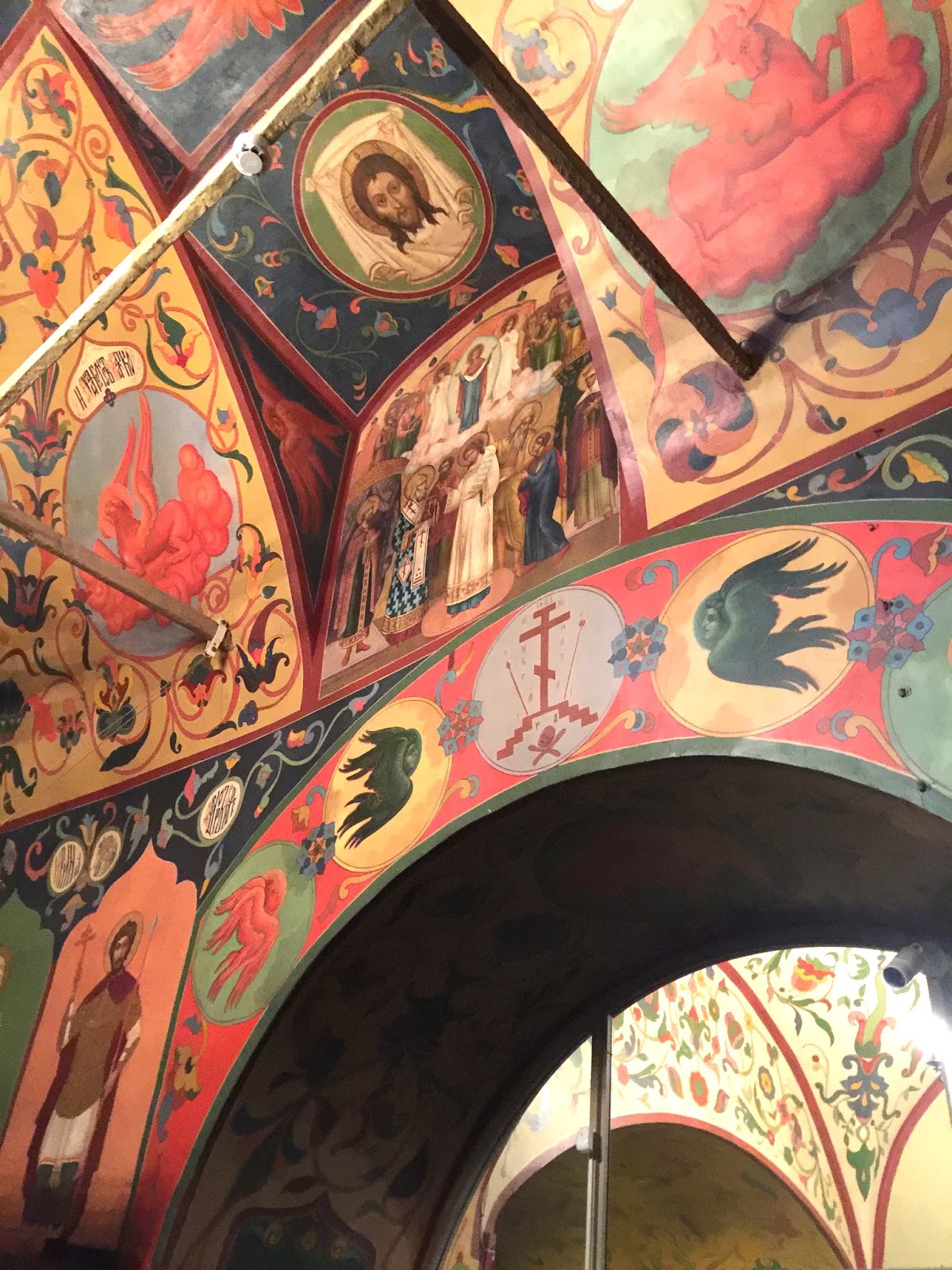
Almost everyone knows how beautiful and pleasant to the eye is the Saint Basil Cathedral. I could just sit at one corner, sipping coffee and stare at this 455 year old colorful church all day. It doesn’t matter whether or not you’ve seen that from your gadget sitting far away from where it is located, i.e. at the Red Square in central Moscow. It still gives the same effect of admiration. Furthermore, the building has been maintained so well, doesn't faded at all. The building, now a museum, is officially known as the Cathedral of the Intercession of the Most Holy Theotokos on the Moat or Pokrovsky Cathedral. Take note that the cathedral opening hours is daily from 11.00 to 17.00, and closed on Tuesdays.


We joined the queue line at 12.30 noon that day. It was not that long queue anyway as most of the tourist were enjoying their lunch break. There is only 1 entrance adjacent to the ticket booth, i.e. as above photo. I let Anne sat at the bench and enjoying the scenery of Kremlin whilst I purchased the ticket. The cathedral was our last visit place together. It was such a long journey that we've gone through since May 2013. We've covered 16 countries by air flight, trains, boat and buses within 2 years and 6 months traveling together. There are so many places of interests that we've been at, thus far. A real pleasant journey, I must say, just the 2 of us. I now decided to take a break for at least 2 years, reminiscing those good moments and enjoying a peaceful wisdom.


Back to the historical story of the cathedral. It was built from 1555 till its completion in 1561 on orders from Ivan the Terrible, i.e. the Grand Prince of Moscow ruling from 1533 to 1547 and 'Tsar of All the Russias' from 1547 until his death in 1584. It was to commemorate the 1552 capture of Kazan and Astrakhan from Mongol forces. That's pretty much all the genuine history that's known about this celebrated landmark. There, however, scores of legends. Nothing is known about the builders, Barma and Postnik Yakovlev, except their names and the dubious legend that Ivan had them blinded so that they could not create anything to compare. Historians unanimously state that this is nothing but urban folklore. Take note that the same folklore were said happened to the Taj Mahal builder, I mean the Emperor, Shah Jahan also took their eyes. Anyway, this world famous landmark was the city's tallest building until the completion of the Ivan the Great Bell Tower in 1600, seated adjacent to it. Its architectural ensemble of inimitable beauty and grandeur has been filling the Russian hearts with joy, excitement and pride.


The original building, known as Trinity Church and later Trinity Cathedral, contained 8 side churches arranged around the 9th, central church of Intercession. The 10th church was erected in 1588 over the grave of venerated local saint Vasily or Basil. In the 16th and 17th centuries, the church, perceived as the earthly symbol of the Heavenly City, as happens to all other churches in Byzantine Christianity. It was popularly known as the "Jerusalem" and served as an allegory of the Jerusalem Temple in the annual Palm Sunday parade attended by the Patriarch of Moscow and the tsar.


The capture of Kazan was the reason for the construction of the cathedral in keeping with the vow made by the czar, but the program of dedicating the cathedral’s side churches was wider than that. It reflected major events of the Russian spiritual life of the second half of the 16th century such as the appearance of a new icon of St. Nicholas the Miracle Worker in the land of Vyatka, and the glorification of saints particularly venerated by the Russian ruler, St. Alexander of Svir, St. Varlaam of Khutyn and St. Vasily the Blessed of Moscow, Fool for Christ.


The building is shaped as a flame of a bonfire rising into the sky, a design that has no analogues in Russian architecture. Dmitry Shvidkovsky, in his book Russian Architecture and the West, states that "it is like no other Russian building. Nothing similar can be found in the entire millennium of Byzantine tradition from the fifth to fifteenth century ... a strangeness that astonishes by its unexpectedness, complexity and dazzling interleaving of the manifold details of its design". The cathedral foreshadowed the climax of Russian national architecture in the 17th century.


As part of the program of state atheism, the church was confiscated from the Russian Orthodox community as part of the Soviet Union's anti-theist campaigns. It has been operated as a division of the State Historical Museum since 1928. It was completely and forcefully secularized in 1929 and remains a federal property of the Russian Federation. The church has been part of the Moscow Kremlin and Red Square UNESCO World Heritage Site since 1990. It is occasionally being mislabelled as the Kremlin owing to its location on Red Square in immediate proximity of the Kremlin.


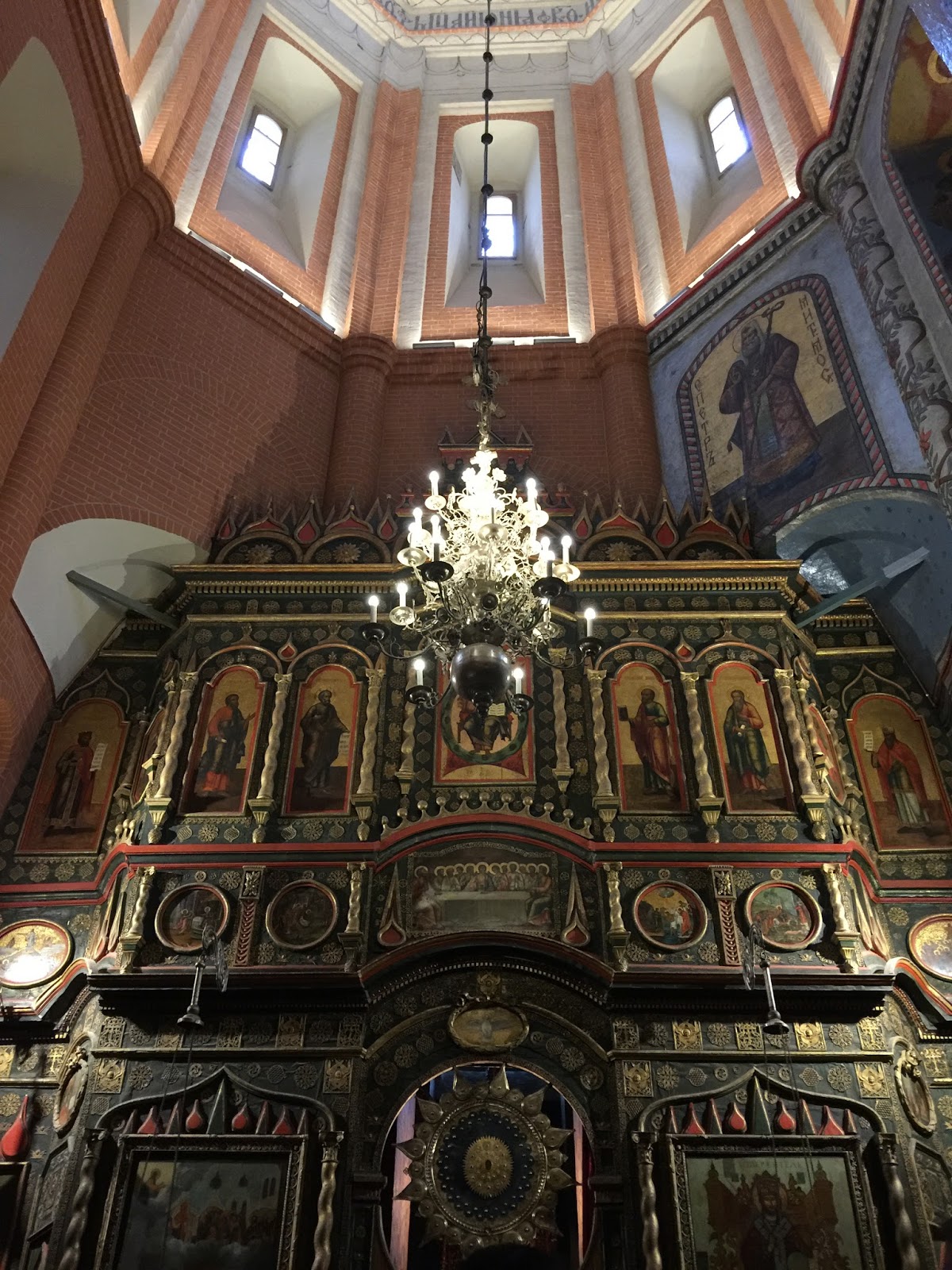
Architectural specialists are to this day unable to agree about the governing idea behind the structure. Either the creators were paying homage to the churches of Jerusalem, or, by building eight churches around a central ninth, they were representing the medieval symbol of the eight-pointed star. The original concept of the Cathedral of the Intercession has been hidden from us beneath layers of stylistic additions and new churches added to the main building. In fact, when built, the Cathedral was all white to match the white-stone Kremlin, and the onion domes were gold rather than multi-colored and patterned as they are today. We were happened to be at the centre church, the ninth when a group of choir, 4 mens started singing a songs from the Holy Book. As it was in Hebrew, which sounded more like Italian, I could not figured out whether it was the collection of song from the Psalm. It was such an harmony sound that fills the entire area.


The Soviet Union, at one time, did having a serious thought of demolishing the cathedral. It was mainly because it hindered Stalin's plans for massed parades on Red Square. The courage of the architect Pyotr Baranovsky has saved the Saint Basil from historical disappearance. When ordered to prepare the building for demolition, he refused categorically, and sent the Kremlin an extremely blunt telegram. The Cathedral remained standing, and Baranovsky's conservation efforts earned him five years in prison. During restoration work in the seventies, a wooden spiral staircase was discovered within one of the walls. Visitors now take this route into the central church, with its extraordinary, soaring tented roof and a fine 16th Century iconostasis. You can also walk along the narrow, winding gallery, covered in beautiful patterned paintwork. One service a year is held in the Cathedral, on the Day of Intercession in October.


We spent less than an hour inside as we both kept looking at the time, feeling worried if we will be late to reach Domodedovo Airport. Though time was not on our side, we truly had a great time, being able to cover at least 3/4 of this beautiful cathedral. It's not wrong to say that Saint Basil Cathedral is indeed a jewel of Moscow. A visit to the city without stepping inside the church would not be a complete tour. My apology for sharing too many photos of this last visited place. I really cannot contain my happiness, I mean having able to record the details of this magnificent place. My main reference for this entry are the Wikipedia and local website, Moscow Saint Basil Cathedral. Thank you for a complete facts of history provided in both websites. I have a full picture of the place and I hope you may gain some knowledge too out of it.


I left Saint Basil Cathedral that day feeling accomplished. Saying goodbye was a little hard to do, hence below are my 2 last photo that I shall again and again revisit in the future, in the event I miss it.


Saturday, May 21, 2016

Moscow - Lunch at Osteria Mario, Okhotny Ryad Shopping Mall

Date: 24th October 2015

First and foremost, I must share the link to the restaurant website, Osteriamario Moscow for your easy reference. They have 3 outlets altogether in the city alone. They brought the food, the interior and the whole feeling of an Italian cuisine into the Moscow city. We were in a rush that day and we found this restaurant located on lower level of the shopping mall, by mere chance. Beneath the restaurant is the Okhotny Ryad Metro Station. For those who wanted to have lunch and a tour at the Red Square thereafter, may fried Metro Lines and descend down at Okthotny Ryad station.


Okay, now the story behind the place. We found ourselves at a Manege Square, a large pedestrian open space in the Tverskoy District from where we were coming from, i.e. the Moscow Metropol Hotel after a delightful tour of the Moscow Metro Lines & Stations. The square is bound by the Hotel Moskva to the east, the State Historical Museum and the Alexander Garden to the south, the Moscow Manege to the west, and the 18th-century headquarters of the Moscow State University to the north. The square forms a vital part of downtown Moscow, connecting the Red Square, stretches behind the Iberian Gate immediately to the south with the major traffic artery Tverskaya Street. The place is accessible by 3 Moscow Metro stations, Okhotny Ryad, Ploshchad Revolyutsii, and Teatralnaya. We were down there earlier in the morning visiting those mentioned station.


2 lovely local ladies in the above photo who occupied the next table were very friendly to us. None of them can speak English but words of food are an easy communications ever, suffice for everyone to communicate and feeling love. Both had a kid who played around after their meal at the huge mall. And the 2 best friend were having good time with coffee after the meal while waiting for their children gets tired from running around. 


For lunch, I thought of having a local Russian cuisine. I knew that there are plenty of selection (seafods and vegetables) for Muslim to eat. However, Anne wanted to try an Italian cuisine. At that time, we were right in front of Okhotny Ryad Shopping Mall. The building has a big frontal sign of “Jamie’s Italian”. And seriously, yes, it is a restaurant by the famous British chef Jamie Oliver who finally opened a branch in Moscow city. This is where Jamie’s Italian is located. Jamie Oliver started taking over Russian restaurant market with Jamie’s Italian first in St. Petersburg. The place in St Petersburg has gained a lot of popularity among locals and tourists. Hence, it justified their official opening in Moscow, being second in the country.


But, we did not had our lunch in Jamie’s Italian. Rather, we were at Osteria Mario another network of Italian restaurants also established in Moscow. Osteria Mario had a few favorite Italian dishes, such as a true Roman pizza on thin crust of Italian flour, flavored "Minestrone" of roasted vegetables, fresh pasta and risotto sprinkled with parmesan cheese, strong ristretto, which will lead to life after a hearty dinner and not forgotten their Tiramisu that come with dark chocolate shavings. For such a fine dining restaurant, the foods are charge at affordable prices and with fresh, natural Italian products as what they claimed. Their pasta, pizza, tiramisu, seafood, cheeses and bruschetta and all other favorite Italian dishes and a tasty coffee is something we had no regret at tasting.


Besides, I personally like their set-up. Furniture, dishes, tablecloths, all elements of the interior Osteria Mario had an element of Italian environment. The first Mario Osteria restaurant was manually created with a chandelier of 100 porcelain bells, brought from Venice. A bright and large posters of their charismatic Mario are the decoration of each restaurant.


You may use below entrance, turn to the left and straight by the corner there's a Osteria Mario sign, unfortunately in Russian writing, large enough for anyone to see.

Okhotny Ryad Shopping Mall

Friday, May 20, 2016

Moscow - Metro Lines & Beautiful Underground Stations

Date: 24th October 2015

It’s important to note that a visit to any of 200 Moscow Metro Stations and taking a short ride to any destination of the 12 dedicated Moscow Metro Lines is a must do activity to all tourist. For the record, the Moscow Metro is also the busiest metro system outside of Asia and the 5th longest in the world as of now. The Moscow Metro is a rapid transit system serving Moscow city and the neighbouring Moscow Oblast towns of Krasnogorsk, Reutov and Kotelniki. It was opened in 1935 with the first 11 kilometre line and 13 stations, being the first underground railway system in the Soviet Union. As a comparison, the first Paris Metro line was opened in the year 1900, July 19.

The most beautiful station, all above 200 stations, Mayakovskaya 

Bas-relief by G.I. Motovilov entitled "The Defenders of Russia" at Smolenskaya Station on Line 4

As of 2016, the Moscow Metro has 200 stations and its route length is 333.3 km consist of 12 Lines. The system is mostly underground, with the deepest section recorded is at 73.6 metres depth, at the “Park Pobedy” station, one of the world’s deepest underground station. For information, Metro station “Abbesses” at 40 meters depth is the deepest underground metro station in Paris which we visited in 2014. The Moscow Metro was one of the USSR’s most extravagant architectural projects with the intention of building palaces for the people. The project was built when Stalin was in power, the metro’s artists and architects went about designing stations that were to epitomize the Russian word ‘svet’, meaning radiance and brilliance and ‘svetloe budushchee’ means a radiant future. This project was used an opportunity to showcase the country’s power. With their reflective marble walls, high ceilings and grandiose chandeliers, many of Moscow’s Metro stations are likened to famous European palaces.


As well as being one of the most efficient and cheapest underground transit systems in the world, the Moscow Metro is also undoubtedly one of the most beautiful. The brainchild of the tsars but finally put into action by Stalin, whose idea to make the city’s metro stations “palaces for the people” has translated into some truly spectacular, subterranean architectural gems. It’s possible to spend an entire day or more travelling the metro and exploring the vast array of ornate stations; each constructed and decorated in its own unique way. Here are few with 2 photos each, of the stations that we visited during that short period of time, out of Moscow’s 200 stations.


1. Mayakovskaya Station seated on Line 2, i.e. the Zamoskvoretskaya Line which is within the Tverskoy District of central Moscow. It is considered to be one of the most beautiful station in the system, a fine example of pre-World War II Stalinist Architecture and one of the most famous Metro stations in the world. The name as well as the design is a reference to Futurism and its prominent Russian exponent Vladimir Mayakovsky. The station was built as part of the second stage of the Moscow Metro expansion, opening on 11 September 1938. It is located 33 meters beneath the surface and became famous during World War II when an air raid shelter was located in the station. Alexey Dushkin's Art Deco architecture was based on a Soviet future as envisioned by the poet Mayakovsky. The station features streamlined columns faced with stainless steel and pink rhodonite, white Ufaley and grey Diorite marble walls, a flooring pattern of white and pink marble, and 35 niches, one for each vault. Surrounded by filament lights there are a total of 34 ceiling mosaics by Alexander Deyneka with the theme "24-Hour Soviet Sky."

A beauty of Mayakovskaya Station, named after the poet, Vladimir Mayakovsky


2. Smolenskaya Station is on Line 3 or the Arbatsko-Pokrovskaya Line. It was built in 1953 to replace an older station of the same name. That older station however was later reopened as part of the Filyovskaya Line which is on Line 4 but the two stations are not connected. Smolenskaya has square of white marble columns with fluted corners, decorative cornices, and ventilation grilles concealed behind ornamental sconces. At the end of the platform is a bas-relief by G.I. Motovilov entitled "The Defenders of Russia," which depicts soldiers of the Red Army in battle. The architects of the station were Igor Rozhin and G. P. Yakovlev. It is located at 50 m below the surface, Smolenskaya was the deepest station on the line until 50 years later where Park Pobedy was opened in 2003.


3. Ploschad Revolyutsii located on Line 3 is indeed an impressive station. It was opened in 1938, features no less than 76 magnificent bronze statues of soldiers, farmers, schoolchildren, workers and a whole host of other characters who helped “defend the Soviet nation”. One of the statues, a dog, is said to bring good luck to those who rub its nose, so make sure you rub the dog nose if you found it. Ploschad Revolyutsii is at the last stop of the Arbatsko-Pokrovskaya Line (Line 3). It is the best stop for visiting Red Square, means you may access to the surface at this station. The station was opened in 1938. The architect responsible for the magnificent works was Alexey Dushkin. The station features red and yellow marble arches resting on low pylons faced with black Armenian marble. The spaces between the arches are partially filled by decorative ventilation grilles and ceiling tracery. Each arch is flanked by a pair of bronze sculptures by Matvey Manizer depicting the people of the Soviet Union, including soldiers, farmers, athletes, writers, aviators, industrial workers, and schoolchildren, 76 sculptures altogether.


4. Paveletskaya Station is also on the Zamoskvoretskaya Line 2 of Zamoskvorechye District, Central Administrative Okrug. It was opened in 1943 and was designed by S.V. Lyashchenko and E.S. Demchenko. Paveletskaya features a tall white marble pillars decorated with the hammer and sickle and a high, arched ceiling. The walls are faced with white marble. Paveletskaya was originally built to a design by Alexey Dushkin as a temporary deep, i.e. 33.5 meters underground as pylon station without a central hall. But it was converted as a fully functional station commencing in 1950 and the station was reopened February 21, 1953. We may still see fragments of original pylons that were left retained in the southern end of the station. The rest of it has been expanded to a spacious column type hall of the same structure as Mayakovskaya. Bronze-coloured inserts with hammer and sickle motive, the sole example of figurative art in this station, were actually painted ceramic castings.


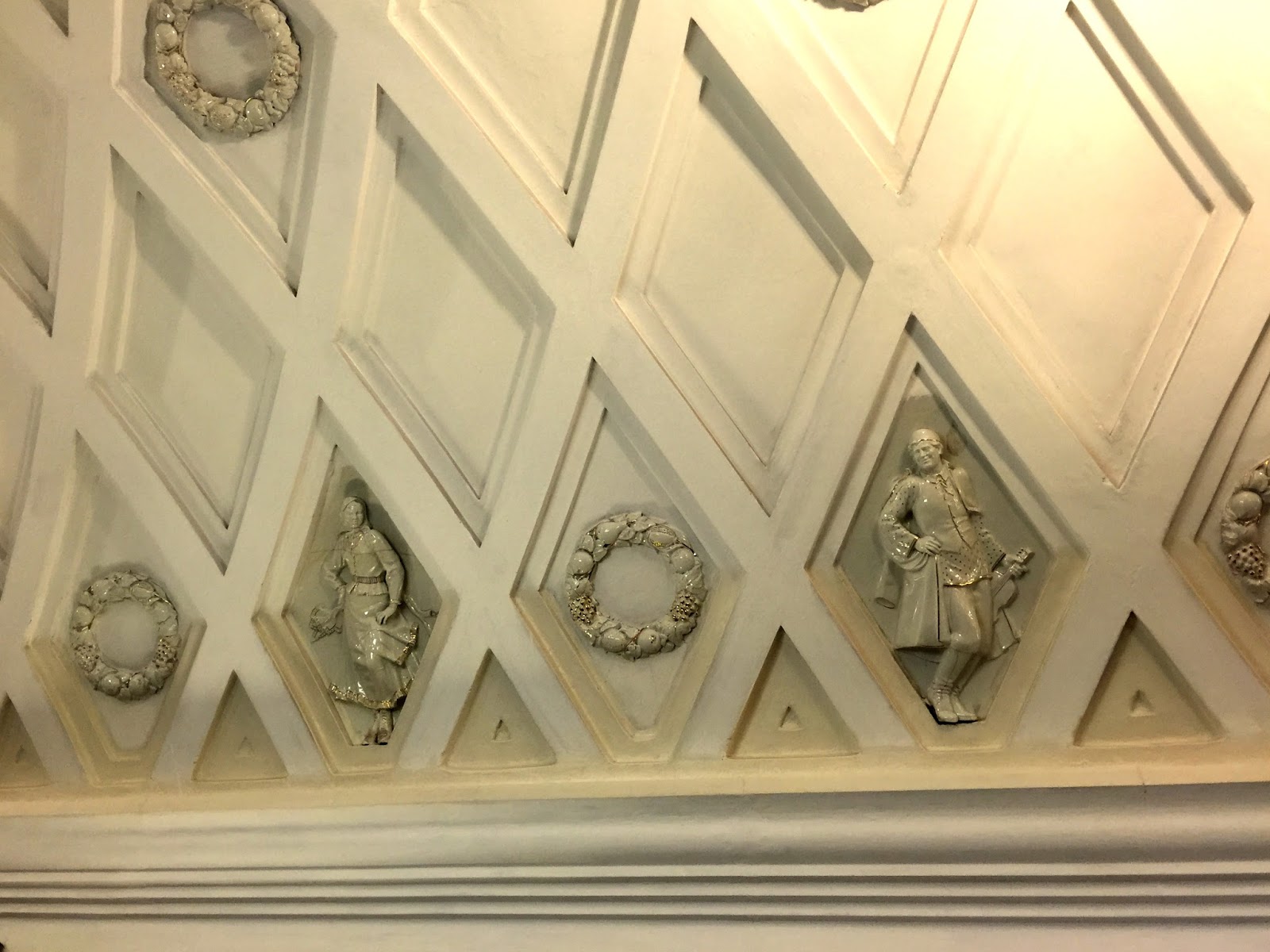
5. Teatralnaya Station is another underground station on Line 2, named for the nearby Teatralnaya Square, the location of numerous theaters, including the famed Bolshoi Theatre. The station is unique in the sense that it does not have its own entrance halls. The north escalator leads to Okhotniy Ryad and the south escalator to Ploshchad Revolyutsii. Teatralnaya Station has fluted pylons faced with labradorite and white marble taken from the demolished Cathedral of Christ the Saviour. Crystal lamps in bronze frames attached to the center of the room that give the central hall its festive appearance. The vault of the central hall is decorated with caissons and majolica bas-reliefs by Natyla Danko on the theme of theatre arts of the USSR, manufactured by Leningrad Porcelain Factory. These bas-reliefs are a series of 14 different figures, each representing music and dance from various nationalities of the Soviet Union. Seven male and seven female figures attired in their national costumes are either performing an ethnic dance or are playing a distinctively ethnic musical instrument. The series included Armenia, Byelorussia, Georgia, Kazakhstan, Russia, Ukraine and Uzbekistan. Each figure is reproduced 4 times for a total of 56 figures. Initially, the floor was of black-and-yellow granite patterned as a chessboard; however in 1970, the yellow panels were replaced with gray.


Beauty is in the eyes of beholder. It is a very subjective matter for debates. Anne has listed 3 stations in her opinion worth for visit, i.e. Mayakovskaya, Taganskaja and Kiyevskaya on the last 4th leg. We only visited 1 out of 3 since the other 2 are on Line 5, Koltsevaya in the Dorogomilovo District, Western Administrative Okrug, Moscow. Time was not on our side. Therefore, when I returned next to Moscow, I shall by all means reach those 2 stations. In addition, there are other stations from my research that worth a visit beside those 5 that I’ve been at. They are, Novokuznetskaya, Avtozavodskaya, Arbatskaya, Elektrozavodskaya, Komsomolskaya, Prospekt Mira, Novoslobodskaya, Pushkinskaya, Kuznetsky, Nagatinskaya, Dostoyevskaya and Park Pobedy, the deepest station among all. 14 stations left to visit.


Moscow Transport Department has created a website for foreign tourist to use a friendly Metro maps that is really helpful for anyone to use them, at a provided link, "Vestibule Map". One of the ideas of the new map is to increase the role of commuter trains and surface transport in the Moscow transportation system. Using surface transport reduces the load on the Metro and is often faster and more convenient. For example, getting from Schukinskaya to Sokol via Metro requires traveling through 11 stations and a transfer, while taking the tram is faster and easier. The map shows the routes that connect neighboring Metro lines, but does not include any details or intermediate stops. Only the routes with waiting time of less than ten minutes are chosen, as the main aim is to provide passengers with a faster travel alternative. Transfer stations of commuter trains and bus stops are marked with circles, just like Metro transfer stations. Aeroexpress, trolleybus, tram and bus (including express bus) routes also maintain this style.


I hope this entry would assist many of you who plan a visit to Moscow. Take my advice, please include Moscow Underground Stations in your itinerary, beside a Red Square which has plenty more to see. Red Square and Moscow Metro Stations are the 2 landmarks that portrays what the Moscow's are, a jewel!