Labels

Showing posts with label Jaipur. Show all posts

Tuesday, March 19, 2013

Jaipur, Jairgarh Fort - Rajasthan State

Tour date: 2nd July 2009


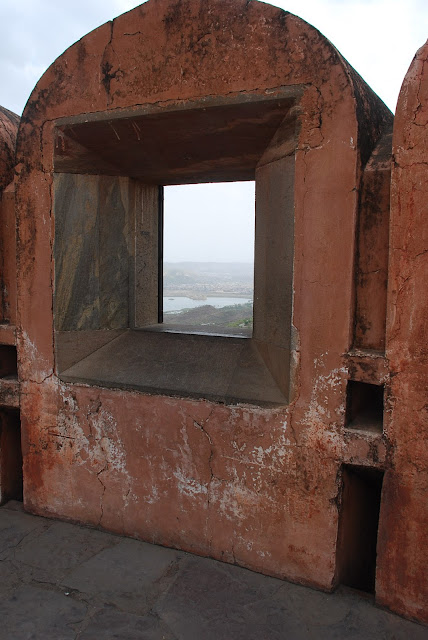
The massive Jaigarh Fort was built in 1726 and holds great appeal for military lovers. Flanked by towering gateways and watchtowers, it contains the world's largest cannon on wheels. The cannon has never been fired though, and neither has the fort been captured. As a result the fort has remained intact over its long life, and is very well preserved. In fact, it's one of the best-preserved military structures of medieval India. Jaigarh doesn't have the delicate interiors of Amber Fort, and therefore appears as a real fortress. You may want to climb the Diwa Burj watchtower to get an excellent view over the plains, like I did.


Jaigarh Fort is situated on the cape called the Cheel ka Teela (Hill of Eagles) of the Aravalli range, overlooking the Amber Fort and the Maota Lake. The fort was built by Jai Singh II in 1726 to protect the Amber Fort and its palace complex and was named after him.


Jaigarh Fort is located not far from the Amber Fort and connected through a secret tunnel in north of Jaipur. It is within a walking distance of Amber Fort but you must physically fit and ready for the adventure to do that. I went there from Amber palace by car. An entry cost is only Rs50 and the fort is open from 9am to 4.30pm daily.


The fort, rugged and similar in structural design to the Amber Fort, is also known as Victory Fort. It has a length of 3 kilometres along the north-south direction and a width of 1 kilometre (0.62 mi). The fort features a cannon named "Jaivana", which was manufactured in the fort precincts and was then the world's largest cannon on wheels. The palace complex (Laxmi Vilas, Lalit Mandir, Vilas Mandir and Aram Mandir) located within the fort has a well-tended garden where the royal family resided, the Shubhat Niwas (an assembly hall of the warriors), an armoury and a museum. Jaigarh Fort and Amber Fort are connected by subterranean passages and considered as one complex.


During the reign of the Mughal Emperor, Shah Jahan, Jaigarh Fort, which is located 150 miles south-west of Delhi, became one of the worlds most efficient Cannon foundry mainly due to the abundance of iron ore mines in the vicinity of the fort. The cannon foundry of the Jaigarh Fort had a massive wind-tunnel that sucked air from the high mountains into its furnace creating temperatures as high as 2400degrees Fahrenheit . The heated air would melt the metal. The liquid molten metal would fill a reservoir chamber and into a cannon mold in the casting pit. Most of those Cannons were massive mostly 16 ft long and had to be prepared within a single day. The Rajput also built a large ingenious mechanical device that had a precision gear system driven by four pairs of oxen, the device was used for hollowing out the Cannon barrels. 


When the Mughal war of succession broke out in the year 1658, Dara Shikoh secured the Cannon outpost of Jaigarh Fort until he was defeated and executed by his younger brother Aurangzeb. Later however, the Mughal Emperor, Muhammad Shah appointed Jai Singh II as the official Mughal Governor of Jaigarh Fort. Ultimately Jai Singh II is known to have molded the great Jaivana Cannon by utilizing the important foundry and devices inside Jaigarh Fort.


The fort was very quite at the time of my visit, maybe it was quite after all due to no occupants, no life beside natures and animals of the abandon place.


Jaipur, Amber Fort & Palace - Rajasthan State

Event date: 2nd July 2009


After about half an hour's drive from the city center, I reached the site of Amer Fort and/or famously called as Amber Palace and Fort. It is set on a hill top overlooking the Maota Lake on northern part of Jaipur. It was originally, a home of Rajput royalty until Jaipur city was constructed. It contains a number of breathtaking palaces, halls, gardens, and temples. You may see inside the fort compound, an elaborate mirror work of Sheesh Minar adds to it's grandeur. The fort entrance is reached by walking up the hill, going in a jeep, or taking a lurching elephant ride.


Frequent buses depart from the Palace of the Winds (Hawa Mahal) to Amber Fort besides available taxis at the hotel doorstep and many other parts of the city. Please take note that an entrance fee of Rs200 for foreigners is charged. Elephant rides are priced at Rs900 rupees for two people. The place is open from 9 a.m. to 4.30 p.m. daily. The elephant rides are only available in the mornings until 11.30 a.m, so, be sure to be there early to get one, as it's not possible to pre-book as the demand is high. I had my ride for the first and I hope it will be the last as during the ride, my heart was enduring the pain of the poor elephant. It was silly of me to think that way.


Sweat even before the giant started walking gracefully :(
Amber Fort was built by Raja Man Singh I and is known for its artistic style, blending both Hindu and Rajput architecture elements. It was built with large ramparts, series of gates and cobbled paths. The aesthetic ambiance of this formidable fort is seen within its walls on a 4 level layout plan (each with a courtyard) in a well turned out wealthy palace complex built with red sandstone and marble consisting of the Diwan-e-Aam or the "Hall of Public Audience", the Diwan-e-Khas or the "Hall of Private Audience", the Sheesh Mahal (mirror palace) and the Sukh Niwas where a cool climate is artificially created by winds that blow over the water cascade within the palace. Hence, the Amer Fort is also popularly known as the Amer Palace. 


On a Stairway to the Palace ground


A pair of birds at Sheesh Mahal

The palace was once lived in by the Rajput Maharajas and their families. At the entrance to the palace near the fort’s Ganesh Gate, there is also a temple dedicated to Sila Devi, a goddess of the Chaitanya cult which was given to Raja Man Singh when he had defeated the Raja of Jessore of Bengal in 1604.


Main entry of the palace fort is through the Suraj Pole (Sun Gate) which leads to Jaleb Chowk, the first main courtyard. This was the place where armies would hold victory parades with their war bounty on their return from battles, which were also witnessed by the Royal family women folk through the latticed windows. This gate was built exclusively and was provided with guards as it was the main entry into the palace. It faced the eastern direction towards the rising Sun and hence the name. Royal cavalcades and dignitaries entered the palace through this gate.

Jaleb Chowk where the elephant rides stop
1st courtyard: An impressive stairway from the Jaleb Chowk leads into the main palace grounds. Here, at the entrance itself to the right of the stairway steps is the Sila Devi temple where the Rajput Maharajas offered worship, starting with Maharaja Mansingh in the 16th century till the 1980s, when the animal sacrifice ritual (sacrifice of a buffalo) practiced by the royalty was stopped .


Ganesh Pol or the Ganesh Gate, named after the Hindu God Lord Ganesh who removes all obstacles in life, is the entry into the private palaces of the Maharajas. It is a three level structure which has many frescoes and was also built at the orders of the Mirza Raja Jai Singh (1621–1627) and leads to the private quarters of the royal family. Above this gate is the Suhag Mandir where ladies of the royal family used to watch through the latticed windows functions held in the Diwan-i-Am.


2nd courtyardThe second courtyard, up the main stairway of the first level courtyard, houses the Diwan-i-Am or the Public Audience Hall. Built with double row of columns, the Diwan-i-Am is a raised platform with 27 colonnades, each of which is mounted with elephant shaped capital with galleries above it. As the name suggests, the Raja held audience here to hear and receive petitions from the public.


3rd courtyardThe third courtyard is where the private quarters of the Maharaja, his family and attendants were built. This courtyard is entered through the Ganesh Pol or Ganesh Gate, which is embellished with mosaics and sculptures. The courtyard has two buildings, one opposite to the other, separated by a garden laid in the fashion of the Mughal Gardens. 


The building to the left of the entrance gate is called the Jai Mandir, which is exquisitely beautified with glass inlaid panels and multi-mirrored ceilings. The mirrors are of convex shape and designed with coloured foil and paint which would glitter brightly under candle nights at the time it was in use. Also known as Sheesh Mahal (mirror palace), the mirror mosaics and coloured glasses were "glittering jewel box in flickering candle light". However, most of this work was allowed to deteriorate during the period 1970–80 but has since then been subjected to a process of restoration and renovation. Carved marble relief panels are placed on walls around the hall. The hall provides enchanting vistas of the Maota Lake.


The other building seen in the courtyard is opposite to the Jai Mandir and is known as the Sukh Niwas or Sukh Mahal (Hall of Pleasure). This hall is approached through a sandalwood door with marble inlay work with perforations. A piped water supply flows through an open channel that runs through this edifice keeping the environs cool, as in an air conditioned environment. The water from this channel was led into the garden.


4th courtyard: The fourth courtyard is where the Zenana (Royal family women, including concubines or mistresses) lived. This courtyard has many living rooms where the queens resided and who were visited by the king at his choice without being found out as to which queen he was visiting, as all the rooms open into a common corridor.


The queen mothers and the Raja’s consorts lived in this part of the palace in Zanani Deorhi, which also housed their female attendants. The queen mothers took deep interest in building temples in Amer town. Jas Mandir, a hall of private audience with floral glass inlays and alabastar (stalagmitic limestone) relief work is also located in this courtyard.


Remarks: Before I arrived in the Amer Palace, I have seen a scene of the Mughal Garden of the Palace from a film "Jodhaa-Akbar", an Indian epic historical drama film released on 15 February 2008. It is directed and produced by Ashutosh Gowariker starring Hrithik Roshan and Aishwarya Rai in the lead roles. It was a beautiful movie where it was shooting in Amer Fort as well as in Fatehpur Sikri.

Monday, March 18, 2013

Jaipur, Albert Hall Museum & Rambagh Palace - Rajasthan State

Event date: 2nd July 2009

I first laid my eyes on this beautiful building while looking at a direction to Chokhi Dhani on the night I arrived in Jaipur City. It look so astonishingly grandeur and outstanding when it was lighted at night. Hence, after I finished my tour to Amber Palace Fort and Jaigarh Fort the next day, I went to look for the building.  


The museum was modeled after the Victoria and Albert Museum in London and is located in Ram Nivas Bagh, south of the Jaipur Old City. Its collection includes portraits of local kings, costumes, woodcarvings, paintings, arts and crafts. Unfortunately photography isn't allowed. A visitor, foreigner is required to pay Rs30. The museum opening hours is from 10am to 4.30pm daily.


Albert Hall Museum is the oldest and the famous museum of the state. It is functions as the State museum of Rajasthan. The building is situated in Ram Niwas garden outside the city wall and opposite of the new gate . It has a fine example of Indo-Saracenic architecture. The building was designed by Sir Samuel Swinton Jacob and was opened as a public museum in 1887. It is also called the Government Central Museum. Maharaja  Ram Singh initially wanted this building to be a town hall, but his successor, Madho Singh II, decided it should be a museum for the art of Jaipur and included as part of the new Ram Nivas Garden. The museum has a rich collection of artefacts like paintings, carpets, ivory, stone, metal sculptures, colourful crystal works etc. It is named after King Albert Edward VII, who visited to the city when he was the Prince of Wales when its foundation stone was laid on 6 February 1876.


A beautiful statue at the roundabout near the Albert Hall museum.


Another beautiful building at Ram Nivas Garden near Albert Hall Museum

Rambagh Palace, now known as Taj Palace Hotel is an impressive Taj Group hotel after being converted from once the famous "Jewel of Jaipur", a Rambagh Palace. It is now Jaipur's most magnificent palace hotel, and was a home to the royal family for over 30 years. The hotel is set among 47 acres of gardens to the south of the Old City. It's been voted the best hotel in Asia and Indian subcontinent.

The front courtyard


The Rambagh Palace is the former residence of the Maharaja of Jaipur, located 5 miles outside of the walls of the Jaipur city on Bhawani Singh Road. It become a preferred choice by celebrities and sport stars across the globe, widely considered to be one of the best hotels around the world.


The first building on the site was a garden house built in 1835 for the wet nurse of prince Ram Singh II. In 1887, during the reign of Maharaja Sawai Madho Singh, it was converted into a modest royal hunting lodge, as the house was located in the midst of a thick forest at that time.


In the early 20th century, it was expanded into a palace to the designs of Sir Samuel Swinton Jacob. Maharaja Sawai Man Singh II made Rambagh Palace as his principal residence and added a number of royal suites in 1931.


After India became independent and the princely states united, the Palace became the Government House. By the 1950s, the royal family felt that the upkeep of the palace and its 47 acres (190,000 m2) of gardens was becoming very costly. They, therefore, decided in 1957 to convert it into a luxury hotel.


I did not have a close view of the inside hotel as we were passing by on our way searching for the Albert Hall Museum at the time the photos was taken.