Labels

Monday, September 23, 2013

Turkey - Capaddocia (2004)

Date of visit: 22nd November 2004


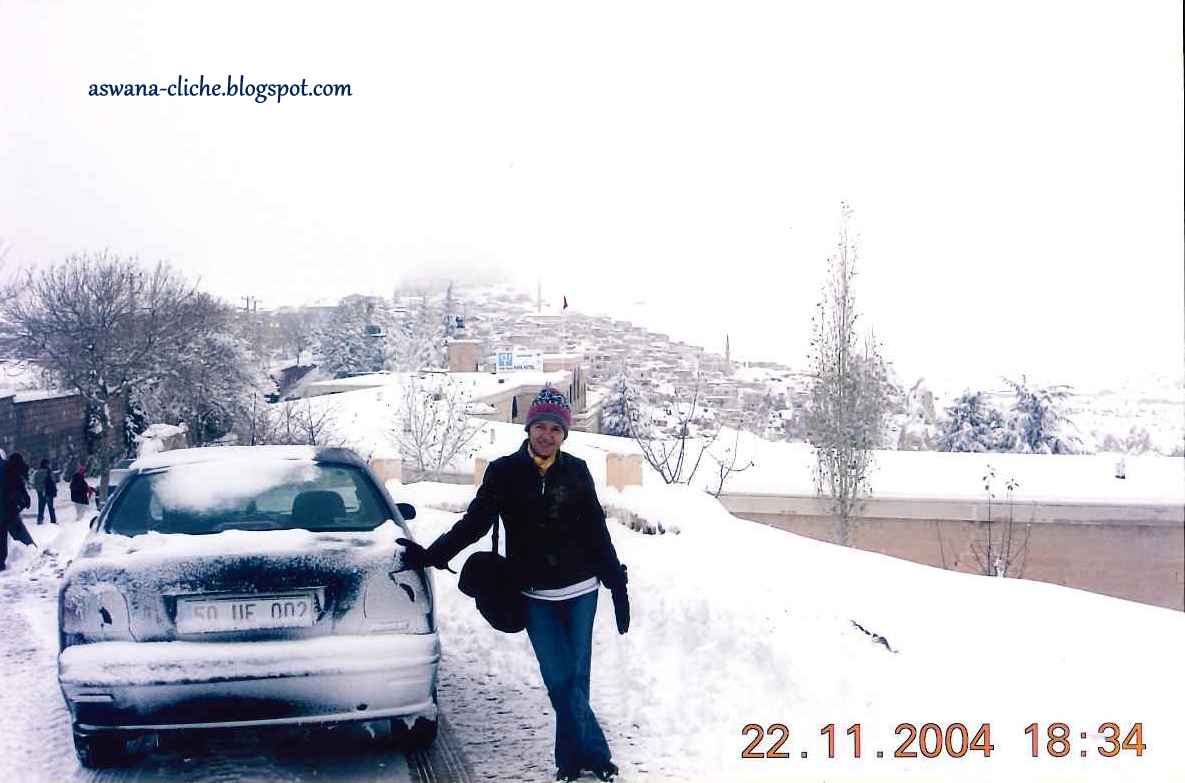
The snow was heavily flooded the city a night before and we woke up to a white serene view, which we took a short opportunity for photos. It is about 233km to reach Capaddocia open air museum in Goreme and natural fortress in Uchisar from Konya. We missed the opportunity to ride a Hot Air Balloon to see the overall view of Goreme valley, a famous activity when in Cappadocia. Nevertheless, we covered other most important towns and destinations in Cappadocia i.e. Goreme, Ihlara Valley and the underground cities worth seeing in Ozkanak. 

Photo with Ainoon's 2 kids in front of the hotel before heading to Goreme
Wake-up on 22nd Nov to this view, a bliss!

Declared as UNESCO World Heritage Site since 1984, seen from its entrance Göreme open-air museum makes for an amazing view, with its tuff peaks and chimneys properly cut to create churches. Goreme is a district of the Nevsehir Province. The complex contains more than 30 carved-from-rock churches and chapels, some having superb frescoes inside, dating from the 9th century to the 11th century.


At the start point of exploring the huge museum, said to be 365 days church of Cappadocia

After the eruption of Mount Erciyes about 2,000 years ago, ash and lava formed soft rocks in the Cappadocia Region, covering a region of about 20,000 km2. The softer rock was eroded by wind and water, leaving the hard cap rock on top of pillars, forming the present-day fairy chimneys. People of Göreme, at the heart of the Cappadocia Region, realized that these soft rocks could be easily carved out to form houses, churches, monasteries. These Christian sanctuaries contain many examples of Byzantines from the post of image breaking period. These frescoes are a unique artistic achievement from this period.


Cappadocia is a renowned historical region in Central Anatolia. In the time of Herodotus (Greek ancient historian, famously known as father of the history), the Cappadocians were reported as occupying the whole region from Mount Taurus to the vicinity of the Euxine (Black Sea). Cappadocia, in this sense, was bounded in the south by the chain of the Taurus Mountains that separate it from Cilicia, to the east by the upper Euphrates and the Armenian Highland, to the north by Pontus, and to the west by Lycaonia and eastern Galatia (all of ancient territory).


Apart from the museum, we had an opportunity of passing by the fairy chimney's rock formation seated nearby of the Gerome area. We did not stop by but merely had appreciate the views from the heated bus. We stopped at Ulchisar, which is situated at the highest point in Cappadocia, on the Nevsehir-Goreme road, just 5 km from Goreme. The top of the Uchisar Castle, provides a magnificent panorama of the surrounding area with Mount Erciyes in the distance.

Zuri snapped this photo with our Turkish tour guide

The famous Ulchisar castle is very different from the castles that you may have visited in Turkey, way out in comparison of Topkapi Palace. It has many rooms hollowed out into the rock which are connected to each other with stairs, tunnels and passages. At the entrances of the rooms, there are millstone doors, just like the ones in the underground settlements, used to control access to these places. Due to the erosion in places of this multi-leveled castle, it is unfortunately not possible to reach all the rooms. Most of the rooms, located on the north side of the castle are in use as pigeon houses today. Farmers used these cave pigeon houses to collect the droppings of pigeons which is an excellent natural fertilizer for the orchards and vineyards.

Among few photos in Ulchisar


After a visit in Ulchisar, the tour guide had arrange a visit to the carpet factory as 1 of their programme to attract us to buy carpet. So, again in here, I did purchased a Turkish carpet in pink colour and was given a certificate from the factory. By noon time, we stopped at a restaurant nearby to the carpet factory. The meals and the ambience were great to warm our bodies. Below photo was the place where we stopped for lunch that day.


Cappadocia also contains several underground cities, largely used by early Christians as hiding places before Christianity became an accepted religion. The underground cities have vast defence networks of traps throughout their many levels. These traps are very creative, including such devices as large round stones to block doors and holes in the ceiling through which the defenders may drop spears. These defense systems were mainly used against the Romans. Below photo was snapped at the kitchen area of the underground city.


The tunnel system also was made to have thin corridors for the Roman fighting strategy was to move in groups which was not possible to do in the thin corridors making it easy to pick them off. The Cappadocian Fathers of the 4th century were integral to much of early Christian philosophy. It also produced, among other people, another Patriarch of Constantinople, John of Cappadocia. For most of the Byzantine era it remained relatively undisturbed by the conflicts in the area with the Sassanid Empire, but was a vital frontier zone later against the Muslim conquests. From the 7th century, Cappadocia was divided between the Anatolic and Armeniac themes. In the 9th–11th centuries, the region comprised the themes of Charsianon and Cappadocia.


We were heading straight to Ankara after visiting the underground cities in a very bad weather and heavy traffic jam due to snows block. Will continue next with Ankara activities.

Friday, September 20, 2013

Turkey - Pamukkale to Konya (2004)

Date of visit: 21st November 2004

Pamukkale is linked to Hierapolis @ known as “Holy City", which was once an ancient city located on hot springs, adjacent to modern Pamukkale in Turkey and currently comprise an archaeological museum designated as a UNESCO World Heritage Site. Pamukkale is a tourist attraction. It is recognized as a World Heritage Site together with Hierapolis. Hierapolis-Pamukkale was made a World Heritage Site in 1988. After spending a night at a nearby resort having fun in a thermal pool, we arrived as early as 8am in Travertine area where there's hardly any crowds.


Geo-technically, the underground volcanic activity which causes the hot springs also forced carbon dioxide into a cave, which was called the Plutonium which carries a meaning “place of the god, Pluto”. It made Pamukkale as Turkey's foremost mineral-bath spa because of its natural beauty. The hot calcium-laden waters spring from the earth cascade over a cliff. As they cool they form a dramatic travertines of hard, brilliantly white calcium that form pools. Pamukkale is also known as "Cotton Fortress" was once a spa since the Romans built the spa city of Hierapolis around it’s sacred warm-water spring. The Sacred Pool is still there, littered with marble columns from the Roman Temple of Apollo. Swimming there is fee. Pamukkale used to be a favorite stop on every backpacker's trip to Turkey. Adventurous travelers would stay in Pamukkale Town's small pensions and hotels, bask in the warm mineral water of the travertine pools, linger over long dinners with drinks in the evening, exchange tales of the road and generally have a wonderful time in this laid-back atmosphere.


Tourism is and has been a major industry in this area. People have bathed in its pools for thousands of years. As recently as the mid-20th century, hotels were built over the ruins of Hierapolis, causing considerable damage. An approach road was built from the valley over the terraces, and motor bikes were allowed to go up and down the slopes. When the area was declared a World Heritage Site, the hotels were demolished and the road removed and replaced with artificial pools. Wearing shoes in the water is prohibited to protect the deposits.

Part of the Hierapolis ruins adjacent to the hot spring

As soon as we finished touring the site and everybody admitted that there's no possible way to spent more time in the hot spring due to cold autumn weather, we left to Konya where we rested for the 5th night in Turkey. On the way, we stopped to see the 13th century Seljukian masterpiece of Sultanhan Caravanserai. I guessed we were lucky as the the snows started falling down. Our group shouted with joys as soon as we saw snows on the roadside. The bus driver was kind enough to stop the bus and let us enjoyed the moment.


The tour guide also admitted that we were the lucky group as the winter came earlier in 2004. When we stopped for lunch at nearby Rest & Service area along the highway, we had more photos. It was almost 6 hours journey on about 400km road. For information, Konya is a death bed of my most favourite poet who happened to be a jurist and a theologian, the renown Jalaluddin Rumi. Should I knew about him years ago, I would not have miss an opportunity to visit his mauseloum.


We stopped at the 13th century Seljuk Sultanhan Caravanserai in a rather cold breezing weather. This time, we were not envying those people who had 4 seasons weather as it was really really cold. I was thankful for the expensive leather jacket that I bought in Kusadasi and a long jane with few layers of long sleeve shirts that I wore that day. Though it's snowing quite heavily, we were not bothered exploring and taking photos as a record of our new experience.


Sultan Han is a large Seljuk Caravanserai located in the town of Sultanhanı, Aksaray Province, Turkey. It is one of the 3 monumental caravanserais in the neighbourhood of Aksaray and is located about 40 km west of Aksaray on the road to Konya. This fortified structure was built in 1229 (dated by inscription), during the reign of the Seljuk sultan Kayqubad I, by the Syrian architect Muhammed Bin Havlan El Dimaski (Damascus) along the trade route from Konya to Aksaray, leading to Persia (the Uzun Yolu). After it was partially destroyed by a fire, it was restored and extended in 1278 by the governor Seraceddin Ahmed Kerimeddin bin El Hasan during the reign of the sultan Kaykhusraw III. This monumental caravanserai then became the largest in Turkey. It is one of the best examples of Anatolian Seljuk architecture.


When we arrived in Konya town, we had an adult night activities; most of us had arranged separately with the bus driver to have a Turkish bath. The next morning, Zuri and myself signed up for Hot Air Balloon ride but the trip was cancelled due to a bad weather.

To be continued....

Thursday, September 19, 2013

Turkey - Ephesus & House of Virgin Mary (2004: Izmir, Kusadasi)

Date of visit: 20th November 2004

There were 3 destination for day 4 in Turkey, i.e. photo stop at Kusadasi coastal city, fashion show cum shopping at Arvalya Leather factory and exploring the ruin city of Ephesus, being 1 of the 7 churches in Asia as mentioned in the Book of Revelation. Later on, before travelling to Pamukkale, we dropped by at House of Virgin Mary which is located about 8 to 9km from Ephesus. Izmir to Kusadasi is about 100km in distance. From Kusadasi, we travelled about 19km to reach Selcuk, where the archaeological site of Ephesus is located.
Quick stop in Kusadasi for photo

As part of the condition joining a guided tour is a stop to the place that made you not hesitates to spend money after travelling thousands of kilometre. I had my purchased which I very much regret in Arvalya Leather factory in Kusadasi. The handbag, priced at more than USD150 was actually damaged and was not used till present, such a waste. Only their expensive leather jacket is useful to me till present though later I found that I bought the jacket at a much higher price.

Fashion show cum  shopping in Turkish leather products factory in Kusadasi

In this entry, perhaps it's better if I could write the history of Ephesus which was once an ancient Greek city, and later a major Roman city situated on the coast of Ionia, near present-day Selçuk, İzmir Province, Turkey for my future reference. It was one of the 12 cities of the Ionian League during the Classical Greek era. In the Roman period, Ephesus had a population of more than 250,000 in the 1st century BC, which served to make it one of the largest cities in the Mediterranean world.The city was famed for the Temple of Artemis (completed around 550 BC), 1 of the 7 Wonders of the Ancient World. In 268 AD, the Temple was destroyed or damaged in a raid by the Goths (Germanic people who responsible for the fall of the Roman Empire).

Celsus Library

Emperor Constantine I rebuilt much of the city and erected new public baths but what remained of the temple was again destroyed in 401 AD by a mob led by St. John Chrysostom in the name of Christianity. The town was partially destroyed by an earthquake in 614 AD. The city's importance as a commercial center declined as the harbor was slowly silted up by the Kayster River causing loss of access to Aegean Sea. Some quoted that The Gospel of John may have been written here. The city was the site of several 5th-century Christian Councils. It is also the site of a large gladiators' graveyard. *Paul the Apostle stayed in Ephesus for 2 years (AD 52-54) teaching the Gospel of Jesus.

Roman Theater and the Gladiators graveyard located not far within

Ephesus was founded as an Attic-Ionian colony in the 10th century BC on the Ayasuluk Hill, 3 km from the center of ancient Ephesus. The Greek mythical founder of the city was a prince of Athens named Androklos, who had to leave his country after the death of his father, King Kadros. According to the legend, he founded Ephesus on the place where the oracle of Delphi became reality ("A fish and a boar will show you the way"). Androklos drove away most of the native Carian and Lelegian inhabitants of the city and united his people with the remainder. He was a successful warrior, and as a king he was able to join the 12 cities of Ionia together into the Ionian League. During his reign the city began to prosper. He died in a battle against the Carians when he came to the aid of Priene, another city of the Ionian League. Androklos and his dog are depicted on the Hadrian temple frieze, dating from the 2nd century. Later, Greek historians such as Pausanias, Strabo, the poet Kallinos, and the historian Herodotos reassigned the city's mythological foundation to Ephos, queen of the Amazons.


The Greek goddess Artemis and the great Anatolian goddess Kybele were identified together as Artemis of Ephesus. The many-breasted "Lady of Ephesus", identified with Artemis, was worshiped in the Temple of Artemis, the largest building of the ancient world according to Pausanias. Pausanias mentions that the temple was built by Ephesus, son of the river god Caystrus before the arrival of the Ionians. Of this structure, scarcely a trace remains.


Rows of Marble columns remain in Celsus Library

Later in the same century, the Lydians under Croesus invaded Persia. The Ionians refused a peace offer from Cyrus the Great, siding with the Lydians instead. After the Persians defeated Croesus, the Ionians offered to make peace but Cyrus insisted that they surrender and become part of the empire. They were defeated by the Persian army commander Harpagos in 547 BC. The Persians then incorporated the Greek cities of Asia Minor into the Achaemenid Empire. Those cities were then ruled by satraps (Persian Governors of Province).


Ephesus continued to prosper. But when taxes continued to be raised under Cambyses II and Darius, the Ephesians participated in the Ionian Revolt against Persian rule in the Battle of Ephesus (498 BC), an event which instigated the Greco-Persian wars. In 479 BC, the Ionians, together with Athens, were able to oust the Persians from the shores of Asia Minor. In 478 BC, the Ionian cities entered with Athens into the Delian League against the Persians. Ephesus did not contribute ships but gave financial support.

The Bazaar

During the Peloponnesian War, Ephesus was first allied to Athens but sided in a later phase, called the Ionian War, with Sparta, which also had received the support of the Persians. As a result, rule over the cities of Ionia was ceded again to Persia. These wars did not much affect daily life in Ephesus. The Ephesians were surprisingly modern in their social relations. They allowed strangers to integrate. Education was much valued. Through the cult of Artemis, the city also became a bastion of women's rights. Ephesus even had female artists. In later times, Pliny the Elder mentioned having seen at Ephesus a representation of the goddess Diana by Timarata, the daughter of a painter.


When Alexander the Great defeated the Persian forces at the Battle of Granicus in 334 BC, the Greek cities of Asia Minor were liberated. The pro-Persian tyrant Syrpax and his family were stoned to death, and Alexander was greeted warmly when he entered Ephesus in triumph. When Alexander saw that the temple of Artemis was not yet finished, he proposed to finance it and have his name inscribed on the front. But the inhabitants of Ephesus demurred, claiming that it was not fitting for one god to build a temple to another. After Alexander's death in 323 BC, Ephesus in 290 BC came under the rule of one of Alexander's generals, Lysimachus.


At a later date, Ephesus became part of the Seleucid Empire (divisional from the empire created by Alexander the Great). After the murder of king Antiochus II Theos and his Egyptian wife, pharaoh Ptolemy III invaded the Seleucid Empire and the Egyptian fleet swept the coast of Asia Minor. Ephesus came under Egyptian rule between 263 and 197 BC. When the Seleucid king Antiochus III the Great tried to regain the Greek cities of Asia Minor, he came in conflict with Rome. After a series of battles, he was defeated by Scipio Asiaticus at the Battle of Magnesia in 190 BC. As a result, Ephesus came under the rule of the Attalid king of Pergamon Eumenes II (197–133 BC). When his grandson Attalus III died without male children of his own, he left his kingdom to the Roman Republic.


When Augustus became emperor in 27 BC, he made Ephesus the capital of proconsular Asia instead of Pergamum. Ephesus then entered an era of prosperity, becoming both the seat of the governor and a major center of commerce. Ephesus has been estimated to be in the range of 400,000 to 500,000 inhabitants in the year 100, making it the largest city in Roman Asia and of the day. Ephesus was at its peak during the 1st and 2nd century AD. The emperor Constantine I rebuilt much of the city and erected a new public bath. Ephesus remained the most important city of the Byzantine Empire in Asia after Constantinople in the 5th and 6th centuries. The basilica of St. John was built during the reign of emperor Justinian I in the 6th century. Majority of what left on Ephesus are 85% in ruin.

Celsus Libray was built in 125 AD in memory of Tiberius Julius Celsus Polemaeanus, an Ancient Greek who served as governor of Roman Asia (105–107)

After riding a bus on a winding road up to the top of the hill, we reached the last residence of the Virgin Mary. A legend, which was first mentioned by Epiphanius of Salamis in the 4th century AD, purported that Mary may have spent the last years of her life in Ephesus. The Ephesians derived the argument from John's presence in the city, and Jesus’ instructions to John to take care of his mother after his death. Epiphanius, however, was keen to point out that, while the Bible says John was leaving for Asia, it specifically does not say that Mary went with him. He later stated that she was buried in Jerusalem. Since the 19th century, The House of the Virgin Mary, about 7 km (4 mi) from Selçuk, is alleged to have been the last home of Mary, mother of Jesus in the Roman Catholic tradition, based on the visions of Sister Anne Catherine Emmerich. It is a popular place of Catholic pilgrimage which has been visited by three recent popes. Only God knows the truth, whether or not the below house was the last place that Virgin Mary accommodated.

A peaceful House of Virgin Mary

Important note: The Epistle to the Ephesians, often shortened to Ephesians, is the 10th book of the New Testament. Its authorship has traditionally been credited to Paul the Apostle, but it is considered by some scholars to be Deutero-pauline, that is, written in Paul's name by a later author strongly influenced by Paul's thought. Scholars have challenged the authenticity of the epistle. Information obtained from Wikipedia.

Wednesday, September 18, 2013

Turkey - Troy, Canakkale & Bergama (2004)

Date of visit: 19th November 2004

On 14th April 2004, the American epic war film “Troy” directed by Wolfgang Petersen, starring Brad Pitt as Achilles with Eric Bana, Orlando Bloom and Diane Kruger was released. The film ends with a speech from Odysseus, "If they ever tell my story, let them say I walked with giants. Men rise and fall like the winter wheat, but these names will never die. Let them say I lived in the time of Hector, tamer of horses. Let them say I lived in the time of Achilles".

The wooden horse from the 2004 "Troy" movie in Canakkale

We arrived in Canakkale city a night before by ferry ride. Çanakkale is a town and seaport in Turkey, in Çanakkale Province, on the southern of Asian coast. The population of this town is slightly above than 100 thousand. Çanakkale Province, like Istanbul Province, has territory in both Europe and Asia sides. Ferries cross here to the northern (European) side of the strait.

Ferry ride, crossing the Dardanelle straits to Canakkale city on 18th Nov 2004

The city is the nearest major town to the site of ancient Troy. The "wooden horse" from the 2004 movie Troy is exhibited on the seafront. Çanakkale is the second city situated on the 2 continents after Istanbul. However Çanakkale is closer to mid-division than Istanbul.


We left quite early in the morning for some pictures at the wooded statue erected in nearby city, not far from the hotel that we stayed for a night. Thereafter, the bus took us to the legendary Troy ruin site about 30km from Canakkale town. Our friendly tour guide who is also a history lecturer gave a briefing of the site, of which I knew quite well from the movie 6 months earlier. So, here I was, setting my foot on the ground where a beautiful Helen caused a heartbreaking war in the name of love.  

Troy ruin site
Zuri & I with 2 of our group member, a contractor in partnership

Troia was added to the UNESCO World Heritage list in 1998. A city was once called Ilium was founded on the site in the reign of the Roman Emperor Augustus. It flourished until the establishment of Constantinople and declined gradually during the Byzantine era. Today, the hill at Hisarlik has given its name to a small village near the ruins, supporting the tourist trade visiting the Troia archaeological site.  The map of the old city shows the adapted Scamander estuary with Ilium a little way inland across the Homeric plain.

Standing in Troy looking at a faraway shoreline, I had a silence wish to visit Greece, a home of Archiles and I did visit Greece, Summer Vacation in Greece in 2008 but had forgotten about Archiles by then

From Troia archaeological site, the bus continue south by the coastal road to reach Pergamon, another ancient historic city. It was a journey of about 200km on the road to Acropolis of Pergamon, an ancient Greek city in Aeolis. The ruin site is currently located 26 kilometres from the Aegean Sea on a promontory on the north side of the river Caicus. Today, the main sites of ancient Pergamon are to the north and west of the modern city of Bergama in Turkey.

Zuri & I at the ruin of Pergamon's library on the Acropolis site

We started to climb the ruin city by 3pm in a nice weather, whilst our tour guide was chatting about the history of the ruin Acropolis. Back then, I was not even paying so much attention but puzzled when he informed that the Great Altar of Pergamon is now in Berlin. What I saw on site was only it's base seated by beautiful sight of the hill.  


After I built an interest of the history told in the 5 Holly Books, I searched the reason why it was taken to a faraway land. The Great Altar of Pergamon is in the Pergamon Museum, Berlin. The base of this altar remains on the upper part of the Acropolis. It was perhaps this altar, believed to be dedicated to Zeus, that John of Patmos referred to as "Satan's Throne" in his Book of Revelation (Revelation 2:13“I know thy works, and where thou dwellest, even where Satan’s seat is: and thou holdest fast my name, and hast not denied my faith, even in those days wherein Antipas was my faithful amartyr, who was slain among you, where Satan dwelleth”). A smaller frieze on a wall inside the Altar of Pergamon depicted the life of Telephus, son of Heracles and legendary founder of Pergamon.


I also had an opportunity to see Pergamon's library on the Acropolis (the ancient Library of Pergamum) which was once the 2nd best in the ancient Greek civilization. When the Ptolemies stopped exporting papyrus, partly because of competition and shortages, the Pergamenes invented a new substance to use in codices, called pergaminus or pergamena (parchment) after the city. This was made of fine calfskin, a predecessor of vellum. The library at Pergamom was believed to contain 200,000 volumes, which Mark Antony later gave to Cleopatra as a wedding present.


We were overnight in nearby city, Izmir located about 100km from Bergama.

To be continued...

Tuesday, September 17, 2013

Turkey - Istanbul (2004)

Date of visit: 17th, 18th & 24th November 2004

It was taken a long time for me to get back on Istanbul, Blue Mosque entry as promised but sadly to say that I don't even have any printed photos save for the inside nor the outside of Blue Mosque though I've searching hard at home. Life has to move on, I better pen off what was left and where I have been during my 3 days in Istanbul. On 17th November 2004, we were visiting Topkapi Palace. I promise you that I will post more photos and more details of the Palace next year. PROMISE!

1 of the corner in Topkapi Palace

On our first night, we were having a diner while watching a Belly Dancer performing her beautiful moves. The night weather during autumn was not something to admire. Weather was less than 15 degrees at night but we enjoyed our first night so much. The next day, on 18th November 2004, we were visiting Blue Mosque and again, my apology as I only have below photo of the beautiful dome just outside Blue Mosque entrance to share with. Hippodrome is merely a walking distance, so, our groups were having a short tour there before reaching the Blue Mosque compound. 


I found below photo but could not remember where it was snapped. Perhaps, I will have a chance to return and look for more story to tells. PERHAPS!


But I have more photos in Hagia Sophia happened to be on the treasure box. The building stand so grandeur which are actually visible from the Blue Mosque. I had my pleasure treasuring the view inside the famous church turned mosque and I hope more details story to be shared soon. SOON!

Beautiful Hagia Sophia


More stories with more photos, reserved for next year entry, maybe. Yes, MAYBE! After visiting all important place of interest in Istanbul, we were in Grand Bazaar until it was time for our trip to Canakkale, about 500km journey via bus from Istanbul. The amount of what I spent in Grand Bazaar was beyond imagination.


After our return from Ankara in early winter weather and a heavy traffic congestion due to snow falls, we were enjoying our cruise along Bosphorus Sea on the day we supposed to travel back to Malaysia after 8 days touring Turkey. Below 3 photos were the picture that Zuri and I took with some of our group members.

with Sam, our tour guide from the Tourist Agent

Zuri and I with a family of 6 that we wishes so much to find. It was fun having to spend 8 days with a lovely family

with a kind, generous and charming uncle
to be continued...