Labels

Saturday, February 23, 2013

Beijing - Panda Zoo & Foot Massage Centre

Event date: 6th December 2006, Day 4

We had to check out from a hotel in Beijing after the 3rd night as we were moving to Chengde in the afternoon. The morning was tough for me to handle as the children's were all exhausted from an excited Great Wall visit and a show "Legendary Kung Fu of Chun Yi" a night before. Due to the difficulties to get ready, we were too late for our breakfast as the rest of our group was already at the lobby waiting for us. Husband forbid us from taking breakfast. It was a quite ride and 1 of the aunty offered our kids biscuit but they politely turned down the offer politely by saying that "we are grounded". It was lucky that we managed to get a snacks at the Panda Zoo, at a later stop.


It was very thoughtful of Lily suggesting that our group made a quick stop at the Panda Zoo as 40% are children's though it was not in our original itinerary. We were willing to pay the tickets on our own as the Panda Zoo section had the biggest visitor in Beijing Zoo. Photos of them in the zoo are shared here for remembrance.


We found this beautiful lake full with swans and ducks. How blissful and how Nasrul and I wished to stay longer but the bus was calling to go to the next stop, the Pearl factory. Sigh! 


By 11am, we finished seeing the Pearls. Syahirah and Nasrul posed at the entrance of Pearl's showroom.


Before savouring excellent lunch at "Datang Restaurant" where they prepared the hot fish soup suited for cold weather to warm our body, we were brought to the traditional Chinese foot massage. It was nice (the food massage) and the lane to the place was pretty amazing for photos. Thereafter, we were off to Chengde. 


The next stop was at Nanshan Ski Village in south of Miyun County, 62 km from Siyuan Bridge, Beijing. It occupies a total area of more than 4000 m2. It was a resort of 4 seasons, thus, it offers activities such as skiing, water skiing, grass skiing, sliding and gliding. In shorts, tourist are offered skiing in the winter, hiking in the spring, swimming in the summer and fruit-picking in the autumn. Suitable for all seasons, these activities focus on sports while giving consideration to sightseeing at the same time. The children's had a considerably fun time until late evening. There's no photos taken here as the camera was left in the coach. 

After dinner, we check in at Han Ming Hotel, Chengde. To be continued with Chengde places of attraction.

Friday, February 22, 2013

Beijing - Temple of Heavan

Event date: 9th December 2006

We were back in Beijing on 8th December midnight from Tianjin and was lucky that the tour agent was kind enough to provide an accommodation in a 5 star hotel towards the end of our stay. Our first stop was at an exclusive tour inside the underground city known as Dixia Cheng, a bomb shelter comprising a network of tunnels located beneath Beijing, which has since been transformed into a tourist attraction. It has been called the "Underground Great Wall" because it was built for the purpose of military defense. The complex was constructed during the 1970s in anticipation of a nuclear war with the Soviet Union and was officially reopened in 2000. Visitors were allowed to tour portions of the complex, which has been described as "dark, damp, and genuinely eerie". Dixia Cheng has been closed for renovation since at least February 2008. In 2006, there was operating mall underground. I bought 2 pieces a nice pink and green soft silk material inside. Due to shopping mode, no photos were taken during the visit.  


Thereafter, we went straight to the Temple of Heaven, located in southeast of Beijing is seen as the most holy of Beijing imperial temples. It has been described as "a masterpiece of architecture and landscape design".


 The Temple of Heaven was where the emperor came every winter solstice to worship Heaven and to solemnly pray for a good harvest. Since his rule was legitimized by a perceived mandate from Heaven, a bad harvest could be interpreted as his fall from Heaven's favor and threaten the stability of his reign. So, it was not without a measure of self-interest that the emperor fervently prayed for a very good crop.


In line with the Confucianist revival during the Ming dynasty, the sacred harvest ceremony was combined with the emperor's worship of his ancestors. This embellishment was also, in effect, self interest on the part of the emperor. For according to the Confucian pattern of social organization, just as the emperor respected his ancestors, so a younger brother should respect an elder brother, a wife her husband, a son his father, and a nation's subjects their ruler. Incorporating ancestor worship within the most solemn ceremony of the imperial ritual calendar, indirectly reinforced the social philosophy that perpetuated the emperor's power.


The design of the Temple of Heaven complex, true to its sacred purpose, reflects the mystical cosmological laws believed to be central to the workings of the universe. Hence, complex numerological permutations operate within its design. For example, because the number 9 was considered to be the most powerful digit, you will see that the slabs that form the Circular Altar have been laid in multiples of 9. Similarly within the Hall of Prayer for Good Harvest, the interior 28 columns are divided into 4 central pillars to represent the seasons, 12 inner columns to represent the months and 12 outer columns to represent the 2 hour tranches that make up a day. There are many such examples of this intense numerology at play.


During imperial times, commoners were not allowed to enter the enormous park. Now for a minimal fee, Chinese citizens and foreign tourist can enjoy it all day long. At dawn, there are many people performing their morning exercises. The older person would practicing the slow and flowing movements of Tai Qi (Chi) whilst a younger one performing vigorous karate like punches and kicks. One group might be learning the ancient martial art of sword fighting, while another might be practising a traditional dance. For those who may be interested to witness the scene, it is well worth waking up early one morning and visiting this park to watch such events.


The Temple of Heaven, located in the southeast of Beijing, was the place where royalty prayed for excellent weather and harvest. In Ming Dynasty (AD 1420), the emperor Zhdli built this Temple which covers an area of 2.72 million square meters. The Temple of Heaven has been listed as one of the World Cultural Relics by the UNESCO.


The place open from 8am till 6pm daily at a small fee ticket of low Season, Y10-30 and High Season at Y15-35. Take note of the royal garden at the point of entrance as it was surrounded by big pines. For ease of reference, the overall arrangement and single building both reflected the relationship between the sky and the land. The 2 relationship was the core of the Sense of Universe at that time. The emperors played an important role in that relationship.


Hubby kept on whispering a visit to the "Temple of Nike" throughout the tour. He had enough of the ancient temples. Later, after we finished with a tour inside the Temple of Heaven, the coach drop us at Wanfunjing street to do our free shopping until very late. Shopping in China was really great as the price is overall reasonably cheap and 1 can apply a rule of 50% bargaining power.

Beijing - Great Wall of China

Event date: 5th December 2006

After a tour in Ming tomb and lunch, our group proceeded to the Great Wall of China, recognised as 1 of the wonders of the world. I had a vow (declared to hubby) before we went that I will climb and walk through the great wall as far as it can be and/or allowed to. Let us see if I managed to achieve my mission. I was 40 years old at the time of visit, surely I can! For the record, I climbed and concur Mount Kinabalu in 2001, 5 years before a climb in Great Wall.


Let's get back to the history and the facts of world famous fortification of China. It's a great thing for me to witness a series of fortifications made of stone, brick, tamped earth, wood, and other materials built along an east-to-west line across the historical northern borders of China in part to protect the Chinese Empire against intrusions by various nomadic groups or military incursions by various warlike peoples or forces. Several walls were being built as early as the 7th century BC. Later it was joined together and resulting a bigger, stronger and unified wall to earn it's name as the Great Wall. Especially famous is the wall built between 220–206 BC by the 1st Emperor of China, Qin Shi Huang. I can write and talk in length about the Emperor Qin Shi Huang of the Chin dynasty as he was the 1 who was responsible to unify China as a big China, today. Saddened that little of the wall built by him remains. After his effort, the Great Wall has been on and off rebuilt, maintained, and enhanced. The majority of the existing wall was reconstructed during the Ming Dynasty.


Beside a military purpose, the Great Wall was built as border controls, allowing the imposition of duties on goods transported along the Silk Road, regulation or encouragement of trade and the control of immigration and emigration. Furthermore, the defensive characteristics of the Great Wall were enhanced by the construction of watch towers, troop barracks, garrison stations, signaling capabilities through the means of smoke or fire, and the fact that the path of the Great Wall also served as a transportation corridor.


The Great Wall stretches from Shanhaiguan in the east, to Lop Lake in the west, along an arc that roughly delineates the southern edge of Inner Mongolia. A comprehensive archaeological survey, using advanced technologies, has concluded that the Ming walls measure 8,850 km. This is made up of 6,259 km sections of actual wall, 359 km of trenches and 2,232 km of natural defensive barriers such as hills and rivers. Another archaeological survey found that the entire wall with all of its branches measure out to be 21,196 km. I wish to share the below map of the chronology how the construction of the Great Wall during the Chinese history, found in Wikipedia.
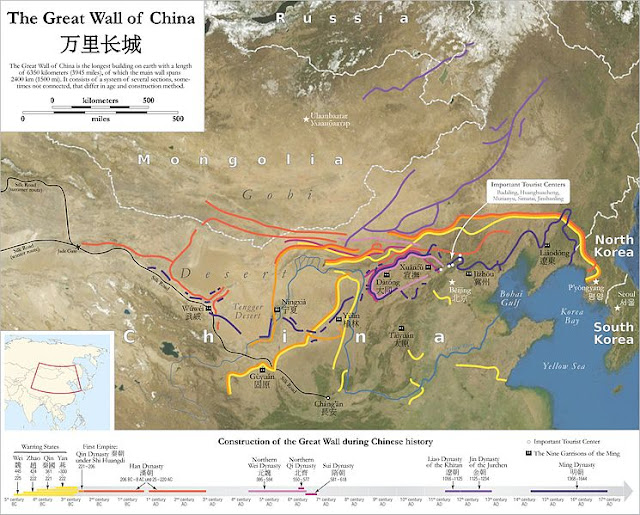
  

From the above map we can see the series of construction by a different emperor in different dynasty as the Chinese were already familiar with the techniques of wall-building by the time of the Spring and Autumn Period between the 8th and 5th centuries BCE. During this time and the subsequent Warring States Period, the states of Qin, Wei, Zhao, Qi, Yan and Zhongshan all constructed extensive fortifications to defend their own borders. Built to withstand the attack of small arms such as swords and spears, these walls were made mostly by stamping earth and gravel between board frames. Emperor Qin Huang Shing conquered all opposing states and unified China in 221 BCE, establishing the Qin Dynasty. Intending to impose centralized rule and prevent the resurgence of feudal lords, he ordered the destruction of the wall sections that divided his empire along the former state borders.


There are 8 sites of the Great Wall open for tourist, starting from the north-west clockwise, are Badaling, JuyongGuan and HuanghuaCheng, then Jiankou and Mutianyu in the north followed by Jinshanling, Gubeikou and Simatai to the north-east. A few desolated sites have been closed by the authorities to prevent further damage to the structures as well as injuries to tourists. We were brought to the site of Badaling. Badaling is the most famous and most visited section of the Great Wall of China, seated approximately 50 miles northwest of urban Beijing city in Yanqing County. The portion of the wall running through the site was built in 1505 during the Ming Dynasty, along with a military outpost reflecting the location's strategic importance. The highest point of Badaling is Beibalou, approximately 1,015 metres above sea level.The portion of the wall at Badaling has undergone heavy restoration, and in 1957 it was the first section of the wall to open to tourists.


There was an older and incomplete wall here during Warring States Period (476 BC - 221 BC). However, wall we are seeing was rebuilt in 1571 and was repaired in 1957 for public access. It is considered the best preserved, being the hallmark of Ming Dynasty wall construction. It became a United Nations world cultural heritage in 1987. The section is about 5 km long with 19 watchtowers. The wall extends from peak to peak and is made of rectangular slabs, standing eight to ten meters high, six meters wide at the base and five meters wide at the ramparts, hence allowing ten soldiers or five horses to stand abreast. Along the wall are observation platforms every 500 meters and they also serve as sentry posts and storage for weapons and food. Many sections of the wall were in desolate places, and food and quarters were supplied via narrow paths to the wall where they are pulled over the side in baskets. Alright, the view from the shared photos evidenced that the steps and the wall were too much for me to explore. Hence, in addition to a thick air of winter season, I was able to catch my breath climb the first part of the steep stairs to reach the first observation platforms. 


Our 3 boys were up above till the last point where the authority disallowed further climb due to safety reason. I stayed behind with Syahirah. We took many photos while waiting for the rest to come down. We were told that the left part of the Badaling wall is steeper but gives a better scenery of the wall. To the east of Badaling is a 2 meter high rock said to be where Dowager Empress Cixi looked towards Beijing in reflection to her previous grand court life-style compared to her then 1900 distress in her fleeing to Xian to escape the Eight Nations Allied Army. This is the rock mentioned earlier, called “Looking to Beijing Rock”, with a monument for foreign contributors to the reconstruction of the Great Wall in the 1980s.


The Great Wall offers a timeless charm to tourists, but scenery varies with seasons. A visit in different time will allow a different scene. In spring, when trees and plants begin to turn green, the Great Wall shall glow with the lush vegetation. Every thing looks so fresh. It is a good time to avoid the crowd tourists in summer and autumn. In Summer, the booming flowers and colored leaves cover the mountains, which will give much nicer scenery by crowded tourist. When fall comes, the mountains are blanketed by colors, creating an amazing view and the weather during this time is pleasant but crowded. This season could be the best season to visit. The mountains and the wall itself are covered with snow in winter, offering an awesome snowy scene. The weather in this time of the year will be frozenly cold and tourists are fewer. It is the best time to get the whole view of the wall. We were there in early winter season when the snowing was not even started. How sad! 


Finally, the hero came down with a victory sign. Nasrul face was reddened from the run.


We couldn't locate Nazhif and Naim, thus, decided to explore the adjacent side door. There, we found a Mongolian lady operating a small business for a tourist to take pictures with her 2 hump camel. They gave a helping hand for Syahirah and Nasrul to had a small ride with the camel.


It's time to say goodbye. To record the reason of my unfortunate mission to climb the many kilometers of the Great Wall, I snapped a picture of hubby climbing down. How scary it was to look down. It's a remarkable attempt that I and Syahirah managed to go up even to the first observatory tower watch.


Lastly, I wishes to share our children's happy faces in the place where 2000 years ago, the Chinese people (uncounted death) had started the construction of the world wonders, Great Wall of China. Their difficulties under the tyranny emperor, their blood and sweat will not be forgotten.


Thursday, February 21, 2013

Beijing - Ming Tomb

Event date: 5th December 2006

It was a Tuesday morning and the winter blue sky was crystal clear when we reached the Thirteen Tombs of Ming Dynasty. The children had times to take their nap in the coach as it was about 50 kilometers journey northwest from the Beijing City to reach the foot of Tianshou Mountain where the tomb was located. Yesterday, we had covered so many places, 8 altogether (Tiananmen Square, Forbidden City, Jingshan Park, National Museum, Hutong, Summer Palace, Tea House and Acrobatic Show), thus, it was a hectic and exhasuted trip for all of us. We had to travel a longer distance as the places we were scheduled to visit seated a bit far from Beijing City on the second day itinerary. Therefore, we could possibly covered few places only. Most importantly was a trip to the Ming Tomb and the Great Wall of China. The tour guide had brought us to see the crystal factory on our way (which was a boring trip) before proceeding with a tour inside the famous tomb.

Nazhif at a front gate, consisting of a three-arches, painted red, and called the "Great Red Gate

Thirteen Tombs of the Ming Dynasty are located within the suburban Changping District of Beijing municipality. The tomb site on the southern slope of Tianshou Mountain (originally Mount Huangtu), was chosen on the feng shui principles by the third Ming Dynasty emperor Yongle (1402–1424), who moved the capital of China from Nanjing to its the present location in Beijing. He is credited with envisioning the layout of the Ming-era Beijing as well as a number of landmarks and monuments located therein. After the construction of the Imperial Palace (the Forbidden City) in 1420, the Yongle Emperor selected his burial site and created his own mausoleum in the tomb.


From the Yongle Emperor onwards, 13 other Ming Dynasty Emperors were buried in this area. The Xiaoling Tomb of the first Ming Emperor, Hongwu, is located near his capital Nanjing. The second emperor, Jianwen was overthrown by Yongle and disappeared, without a known tomb. The "temporary" Emperor Jingtai was also not buried here, as the Emperor Tianshun had denied him an imperial burial; instead, Jingtai was buried west of Beijing. The last Ming emperor was buried at the location was Chongzhen, who committed suicide by hanging himself in Jingshan Park (on 25th of April 1644), was buried in his concubine Consort Tian's tomb, which was later declared as an imperial mausoleum Si Ling by the emperor of the short-lived Shun Dynasty Li Zicheng, with a much smaller scale compares to the other imperial mausoleums built for Ming Emperors. During the Ming dynasty the tombs were off limits to commoners, but in 1644 Li Zicheng's army ransacked and set many of the tombs on fire before advancing and capturing Beijing in April of that year. Please click here to read the story of "Li Zicheng" and "Chongzhen" for the location of where the last ming emperor hang himself. 


The Ming Dynasty Tombs are designated as one of the components of the World Heritage object at present. The site of the Ming Dynasty Imperial Tombs was carefully chosen according to Feng Shui principles. According to these, bad spirits and evil winds descending from the North must be deflected; therefore, an arc-shaped area at the foot of the Jundu Mountains north of Beijing was selected. This 40 square kilometer area — enclosed by the mountains in a pristine, quiet valley full of dark earth, tranquil water and other necessities as per Feng Shui — would become the necropolis of the Ming Dynasty.


Only 3 tombs are open to the public, 1) Chang Ling, the largest, 2) Ding Ling, whose underground palace has been excavated and 3) Zhao Ling. There have been no excavations since 1989, but plans for new archaeological research and further opening of tombs was circulated. The Ming Tombs were listed as a UNESCO World Heritage Site in August 2003. They were listed along with other tombs under the "Imperial Tombs of the Ming and Qing Dynasties" designation. We were touring the most famous tomb, Ding Ling in 2006, thus, many other interested features of the 12 other tombs were not sighted by us.


Dingling literally means "Tomb of Stability", is the tomb of the Wanli Emperor. It is the only one of the Ming Dynasty Tombs to have been excavated. It also remains the only intact imperial tomb to have been excavated since the founding of the People's Republic of China, a situation that is almost a direct result of the fate that befell Dingling and its contents after the excavation. I read the story of Emperor Wanli and his success from the history book and film. During his reign, he had dominated 3 wars from the Mongolian, the Japanese and the Yang Yinglong rebellion. I did not expected to see and visited his richly and highly engineering skilled built tunnel tomb to the modern engineering. At the time of visit, our SMART tunnel project was about to be handed over.


The excavation of Dingling began in 1956, after a group of prominent scholars led by Guo Moruo and Wu Han began advocating the excavation of Changling, the tomb of the Yongle Emperor, the largest and oldest of the Ming Dynasty Tombs. Despite winning approval from premier Zhou Enlai, this plan was vetoed by archaeologists because of the importance and public profile of Changling. Instead, Dingling, the third largest of the Ming Tombs, was selected as a trial site in preparation for the excavation of Changling. Excavation completed in 1957, and a museum was established in 1959. In below photo, a large vault key was in framed form as to preserved.  


The excavation revealed an intact tomb, with thousands of items of silk, textiles, wood, and porcelain, and the skeletons of the Wanli Emperor and his two empresses (Remarks: the empresses and concubines were buried (alive) together with the Emperor at a time of his burial being part of a cruel tradition). However, there was neither the technology nor the resources to adequately preserve the excavated artifacts. After several disastrous experiments, the large amount of silk and other textiles were simply piled into a storage room that leaked water and wind. As a result, most of the surviving artifacts today have severely deteriorated, and many replicas are instead displayed in the museum. Furthermore, the political impetus behind the excavation created pressure to quickly complete the excavation. The haste meant that documentation of the excavation was poor. Lily was explaining the details of the tomb, inside the chamber in below photo.


The lessons learned from the Dingling excavation has led to a new policy of the People's Republic of China government not to excavate any historical site except for rescue purposes. In particular, no proposal to open an imperial tomb has been approved since Dingling, even when the entrance has been accidentally revealed, as was the case of the Qianling Mausoleum (belonging to Tang dynasty in 7th century). The original plan, to use Dingling as a trial site for the excavation of Changling, was abandoned. 2 photos below are the access shaft to tomb chamber, a very massive engineering to built such a massive shafts and chambers similar to a modern technology, as in my recent water cum motorway tunnel project in Kuala Lumpur.


The tomb layout of the ground buildings is square in the front and round in the rear, symbolizing the ancient Chinese philosophy of “Round Heaven and Square Earth”. The magnificent of Dingling Tomb underground palace, 27 meters beneath the ground, covers a total area of 1195 square meters with 5 tall and spacious halls of stone structure with no column. More than 3000 articles buried have been unearthed and on display in the Dingling Tomb Museum.


We explored the ground monument once we surfaced from the exit point. It was a 4 faced column with 4 different kind of Chinese art of writing including in Manchurian. The carved dragon was even more beautiful in the pink marble. We took a considerable lengthy times in the small part of Ming Tomb, including visiting stalls operated by locals selling souvenir items.. If I were to return to the place again, I will definitely explore the Changling tomb in greater details.