Labels

Tuesday, February 26, 2013

Karachi - Mohatta Palace

Event date: 6th February 2010

Karachi is a place where a thousand memory still lingers in my head, a place that I will not exchange in any other place in the world which once been a home to me and my family. The company rented a house for me at a safe residential area in Defence Housing Authority (DHA) and later a comfy apartment in Clifton area. Those places are safe to say as it was guarded from any form of terrorism. The 1st place that I stayed for few months with CLC and CKS with Daim, the driver and the housekeeper/cook was a 2 storey bungalow in Khayaban-e-Hilal, adjavent to beautiful park "Hilal Park". We shifted to Platinum Park, an apartment opposite Abdullah Shah Ghazi, Clifton area as we have many of Malaysian staffs joint us for the project. I will have to write in length about those memory in a later days.


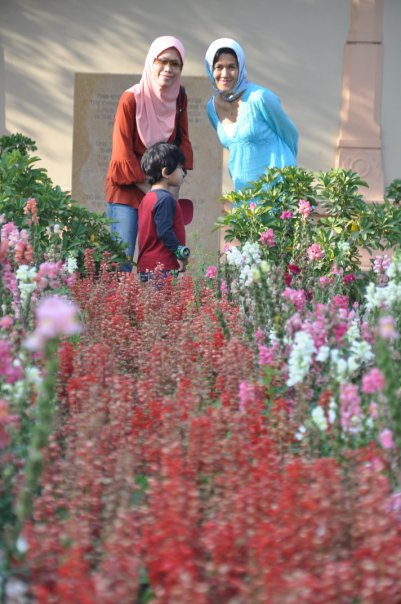
For now, especially today, I thought a lot about my BFF a.k.a Best Friend Forever, Maznah who is now still in hospital undergone her 4th chemoteraphy. Her family and I went to visit the palace on 6th February 2010 with the intention to have our pictures taken in this lovely palace. The palace seated so near to Platinum Park, the apartment that I used to stay with my family. Sadly that I did not visit the beautiful palace during their stay and/or the family reunion in December 2007, 2008 and 2009. Don't be surprise, not even 1 time we went there though the museum palace was so near.


The Mohatta Palace is located in Karachi, Sindh Province in Pakistan. It was built by Shivratan Chandraratan Mohatta, an ambitious self-made businessman from Marwar as his summer home in 1927. The architect of the palace was Agha Ahmed Hussain. However, Mohatta could enjoy this building for only about two decades before independence of Pakistan and he left Karachi for India. After Mohatta's departure to India, the Government of Pakistan acquired the building to house the Ministry of Foreign Affairs in 1947. Fatima Jinnah, the sister of the Quaid-e-Azam Muhammad Ali Jinnah, moved into it in 1964. In the '60s Mohatta Palace was dubbed Qasre-e-Fatima, becoming the hub of her presidential campaign against President Ayub Khan. After her questionable sudden death, her sister Shireen Jinnah moved in to occupy the ground floor for many years. With her death in 1980, the palace was sealed.


In 1995 it was purchased by the Government of Sindh for its conversion into a Museum devoted to the arts of Pakistan. As a result of the interest taken by the Government of Sindh who took over the ownership of the property and appointed an independent board of trustees headed by the Governor, to formulate recommendations on how best to adapt and use the palace. The trust was established to manage the property and ensure that it would not be sold or utilised for commercial or any other purpose other than that stipulated in the trust deed. Funds for the acquisition of collections for the museum and the construction of an extension will be raised by the trustees through private and public grants, donations and other fund raising activities.The Museum formally opened in 1999. Behind the building can be found a small collection of "English" statues such as Queen Victoria, soldiers of the Raj.


The museum is open all day except on Monday, at a time of, Tuesday to Friday from 11 am to 6 pm and Saturday and Sunday from 12 noon to 7 pm.

Shivratan Chandraratan Mohatta built the Palace in the tradition of stone palaces in Rajasthan, using pink Jodhpur stone in combination with the local yellow stone from Gizri. The amalgam gave the palace a distinctive presence in an elegant neighbourhood, characterised by Mughal architecture or rather a Rajput which was located not far from the sea.

The palace has large stately rooms designed for entertainment on the ground floor and more private facilities on the first floor (converted to an exhibition wall at present), where there is a terrace provided with a shade from intense sunlight. The palace is solely made up of teak wood with a polished staircase, long corridors and doors opening within doors. The "barsati” (terrace) of the Mohatta Palace had a beautiful family temple dedicated to Hindu God, lord Shiva.What many do not know about the Mohatta Palace is the secret underground tunnel that leads from the grounds of the palace all the way to a subterranean Hindu temple less than a kilometer away. This tunnel was apparently built to provide a safe passage for the Hindu wife of Shivratan Chandratan Mohatta to go for her daily worship. The tunnel still exists today, though over time it has caved in, and the entrance is blocked from both ends.


The 6th February 2010 memory with Maznah's family in Mohatta Palace is now being kept in this journal. I was all alone at that time as my family had demobilised to Kuala Lumpur. I had to wait for approval given by my big boss for my transfer date and to arrange the furniture's and all my personal belonging collected during my 3 years stay in Karachi back home. I am indeed indebted to Maznah, Dilla, Ainnie and many more Malaysian friend who had lend me their company, support and assistance during that period of time.

This entry is dedicated to all of my friends back there. Thank you for your friendship.

Saturday, February 23, 2013

Tianjin, Day 6 in China

Event date: 8th December 2006

Our bus had undergone a minor maintenance due to a cold weather, thus, we started a little bit late, allowing us ample temple to check out and had a peaceful breakfast. We headed straight to Tianjin from Chengde and did not overnight in the 3rd largest city in China. The journey was very pleasant with beautiful sight along the road.


What a nice created Retaining Wall, never seen this before

Arriving Tianjin City

A journey to Tianjin took about 1.5 hours. Tianjin means Port to Heavenly Capital. 130 kilometers southeast of Beijing, it serves as Beijing's gateway to the Bohai Sea. People started to settle down in Tianjin during the Song Dynasty (960-1279A.D.). By the 15th century it had become a garrison town enclosed by walls. After several decades of development, Tianjin is now one of China's leading manufacturing and commercial centers. A visit to the famous Food Street and the Culture Street, which was first constructed in the Ming dynasty is a must.


Weather was extremely cold than usual, Syahirah kept hold her ear plug to avoid coldness

Tianjin has a shopping district where they've tried to replicate the old style China. Its called Old Culture Street or Gu Lou. I purchased some traditional clothing and souvenirs here from the site shops for good prices. There are 3 streets of the same theme spreading from this center building. Don't let the expensive look of the side shops scare you, my advice is bargain as low as you like.


Tianjin is one of the four municipalities in China. Its name means 'the place where the emperor crossed the river'. Facing the Bohai Sea, Tianjin, the one time imperial port, serves as Beijing's vital gateway to the sea. In recent years it receives more and more attention from visitors due to its illustrious historical heritage and other natural resources.


It is no exaggeration to say that Tianjin bears a splendid historical background. However, it was desecrated by foreign invaders long before the foundation of People's Republic of China. The city was once shared by nine countries: Italy, Germany, France, Russia, Great Britain, Austria, Japan and Belgium. This marked an extremely hard period for the city and her people because those imperialist countries left permanent marks in her body, most notable of which were thousands of villas. Today those villas provide an exotic flavor, enhancing the beauty of the entire city.

Colonial house in Tianjin
Blessed with variety of attractions, Tianjin is a good place to explore. The top ten attractions are Jinmen Shijing, are Gu Wenhua Jie, Dagu Emplacement, Huangyaguan Great Wall, Dule Temple, Haihe River, Water Park, Panshan Mountain, Hotel Street and Food Street, TV & Radio Tower and Zhonghuan Cailian. There are also many natural scenes of beauty as well as great historical events.


Remarks: There are many Muslim in Tianjin. We had a lovely steamboat at the Muslim restaurant in Beijing. For the first time after 6 days in China we had halal meat for our meal. We were served with fish but it was a fresh water fish which had many fish bones. It was a rich and heavy diner that made we sweat with warm and heartening meal that night. What a blessed day.

Chengde - Little Potala @ Putuo Zongcheng Temple

Event date: 7th December 2006

Putuo Zogcheng Temple is known as Little Potala of Tibet as it was built in resemblance of the the astonishing Potala Temple in Tibet.


The Putuo Zongcheng Temple of Chengde is a Qing Dynasty era Buddhist temple complex built between 1767 and 1771, during the reign of the Qianlong Emperor (1735–1796). It is located near the Chengde Mountain Resort, which is south of the Putuo Zongcheng. Along with the equally famed Puning Temple, it is one of the Eight Outer Temples of Chengde. 


Breathtaking view after passing the entrance gate


The temple was modeled after the Potala Palace of Tibet, the old sanctuary of the Dalai Lama built a century earlier. Since it was modeled after the Potala palace, the temple represents a fusion of Chinese and Tibetan architectural styles. The temple complex covers a surface area of some 220,000 square metres, making it one of the largest in China. Many of its halls and pavilions are adorned with copper and gold tiled roofs, adding to the splendor of the site.


The Putuo Zongcheng Temple is part of the "Eight Outer Temples" located in Chengde, which are part of the World Heritage List along with Chengde's Mountain Resort. These temples were administered by the Lifan Yuan, an administrative department for the affairs of ethnic minorities such as the Mongolians and Tibetans, hence the different combinations of architectural style which could be seen throughout these Eight Outer Temples in Chengde.


The Putuo Zongcheng Temple was originally dedicated to Qianlong in order to commemorate his birthday, as well as provide Hebei with a temple of equal size and splendor as the Tibetan Potala Palace. 


The Putuo Zongcheng temple served more functions than just Buddhist ceremonies and festivals; it was also the location that the emperor would gather meetings of different ethnic envoys from within the empire. The location served as a peaceful getaway in contrast to the bustling life of the capital Beijing, as well as complimented the nearby hunting grounds that the emperor would enjoy with his hosts.


As of 1994, the Chengde Mountain Resort and Chengde's Eight Outer Temples (including the Putuo Zongcheng Temple) were established as UNESCO World Heritage Sites. Today, the temple remains a site of tourism and local festivities.


Remarks: The last 3 photos in this entry was taken at the top @ the highest point of the temple.

Chengde - Mountain Resort

Event date: 7th December 2006

The view in Chengde's mountainous resort is breathtaking though the trees were all almost naked without its leafs, frozen lake, dried grass and temperature down to negative degree. Below photo was what I wish to describe in picture.


The Mountain Resort in Chengde literally mean "Mountain Villa for Avoiding the Heat" is a large complex of imperial palaces and gardens situated in the city of Chengde, Hebei Province, China. Because of its vast and rich collection of Chinese landscapes and architecture, the Mountain Resort in many ways is a culmination of all the variety of gardens, pagodas, temples and palaces from various regions of China. Appropriate season to come here would be in summer, not winter.


Our group photo at the entrance point

Built between 1703 and 1792 during the Qing Dynasty, the Mountain Resort took 89 years to complete. It covers a total area of 5.6 square kilometres, almost half of Chengde's urban area. It is a vast complex of palaces and administrative and ceremonial buildings. Temples of various architectural styles and imperial gardens blend harmoniously into a landscape of lakes, pastureland and forests.


Hubby was wearing a Chinese hat found at the roadside bazaar during our journey yesterday

The Kangxi, Qianlong and Jiaqing emperors often spent several months a year here to escape the summer heat in the capital city of Beijing and the palace zone in the southern part of the resort was therefore designed to resemble the Forbidden City in Beijing. It consists of two parts: a court in front, where the emperor received high officials, nobles of various minority nationalities, and foreign envoys. The bed chambers are in the rear, which were the imperial family's living quarters. The Jiaqing and Xianfeng emperors both died while staying at Chengde in 1820 and 1861 respectively.


The Mountain Resort is most famous for the 72 scenic spots which were named by the Kangxi and Qianlong emperors. Many of the scenic spots around the resorts lake area were copied from famous landscaped gardens in southern China. For instance, the main building on the Green Lotus Island, "Tower of Mist and Rain," is modeled upon a tower in Nanhu Lake at Jiaxing in Zhejiang Province.


The resorts plain area also possesses characteristics of the scenery of the Mongolian grasslands Forested mountains and valleys are dotted with various buildings. This includes a 70 metres tall stone Chinese pagoda, one of the tallest in China, built in 1751 during the reign of the Qianlong Emperor. The pagoda is shaped with an octagonal base, while the pagoda's nine stories are decorated with colorful glazed tiles and the steeple is crowned with a gilded round spire.


In December 1994 the Mountain Resort was listed by UNESCO on its list of World Heritage Sites. There are a museum displaying a fine porcelains and other belongings of imperial palace. Some of the display are in below photo.


Finally, I wish to record the tour and our children's excitement taking a ride at the big resort and it's lakes and parks.